
XRDS-RF UHF Lightning Arrestor
4.6Editor score
Low 0.4dB insertion loss
Brass nickel plated body
PL-259 female connectors
DC to 500MHz range
This guide compares top-rated ham radio lightning protection for antennas to help you choose the best surge protector for your base station or mobile setup.
Protecting your expensive radio equipment from lightning strikes is crucial for any serious amateur radio operator. A quality lightning arrester diverts dangerous surges away from your transceiver and keeps your setup safe during storms.
We evaluated ten highly-rated surge protectors based on construction quality, insertion loss, frequency range, and ease of grounding. Each product was analyzed against industry standards for coaxial lightning protection to ensure reliable performance.
Each pick below highlights key specifications and real-world benefits for different use cases. Remember that product availability and pricing can change over time so check current details before making your final purchase decision.
4.6Editor score

4.6Editor score

4.8Editor score
This comparison table offers a quick side-by-side view of the essential technical specifications for each arrester including connector types and frequency capabilities to help you find the right match for your antenna system.



The XRDS-RF UHF Lightning Arrestor stands out as a top pick for its balanced performance and value. With a solid 4.6 rating it offers dependable surge protection for ham radio base stations using standard PL-259 connectors.
We may earn a commission when you buy through this link, at no additional cost to you.
Its construction features a brass body with nickel plating which resists corrosion in outdoor environments. The internal Teflon insulator ensures stable electrical performance while the design maintains an insertion loss of under 0.4dB.
One trade-off is the need for an external ground cable which is not included in the package. Users must ensure proper grounding to a metal rod or ground plane to maximize safety during electrical storms.
This arrester is ideal for operators seeking reliable protection without overspending. It suits CB and ham radio setups where frequency ranges stay within its 500MHz limit making it a practical choice for many hobbyists.
Nickel-plated brass construction resists rust and ensures consistent performance over years of outdoor use.
Low insertion loss preserves signal strength so your transmission quality remains clear even with the protector in line.
We may earn a commission when you buy through this link, at no additional cost to you.
The Diamond Antenna SP1000 delivers professional-grade protection with a replaceable surge element that extends its lifespan. It earns its position as a top budget-friendly option due to its balance of cost and advanced safety features.
We may earn a commission when you buy through this link, at no additional cost to you.
Its impulse wave discharge capacity of 6000 Amps handles significant energy surges effectively. The wideband capability ensures compatibility across various frequencies while the insertion loss stays remarkably low at under 0.3dB.
While slightly more expensive than basic models the replaceable element means you do not need to replace the entire unit after a major strike. This feature alone can save money and reduce downtime over the long term.
Ideal for serious operators protecting valuable transceivers this arrester is compatible with Diamond SP-Series antennas. Ensure you connect it close to the equipment entry point and maintain a solid ground connection for full protection.
When the surge element is exhausted you can swap it out instead of buying a new arrester entirely.
With 6000Amp discharge capacity it withstands powerful lightning-induced surges that could otherwise fry sensitive electronics.
We may earn a commission when you buy through this link, at no additional cost to you.
The Workman A28 Lightning Arrestor is a straightforward solution for operators needing basic protection without extra features. Its 4.5 rating reflects consistent performance for entry-level ham radio and CB setups.
We may earn a commission when you buy through this link, at no additional cost to you.
It features a convenient ground screw on the side which simplifies the grounding process compared to units requiring external lugs. The PL-259 connectors allow for easy integration into existing coaxial cable lines.
The main limitation is the lack of detailed technical specifications regarding insertion loss or frequency range. This makes it best suited for low-power or lower-frequency applications where maximum performance is not critical.
Choose this model if you need an economical safeguard against occasional electrical surges. It serves well for temporary setups or casual operators who want essential protection without investing in premium hardware.
The built-in side screw provides a reliable point for attaching your ground wire without extra adapters or clamps.
Its low cost makes it an accessible option for anyone building a first antenna system on a tight budget.
We may earn a commission when you buy through this link, at no additional cost to you.
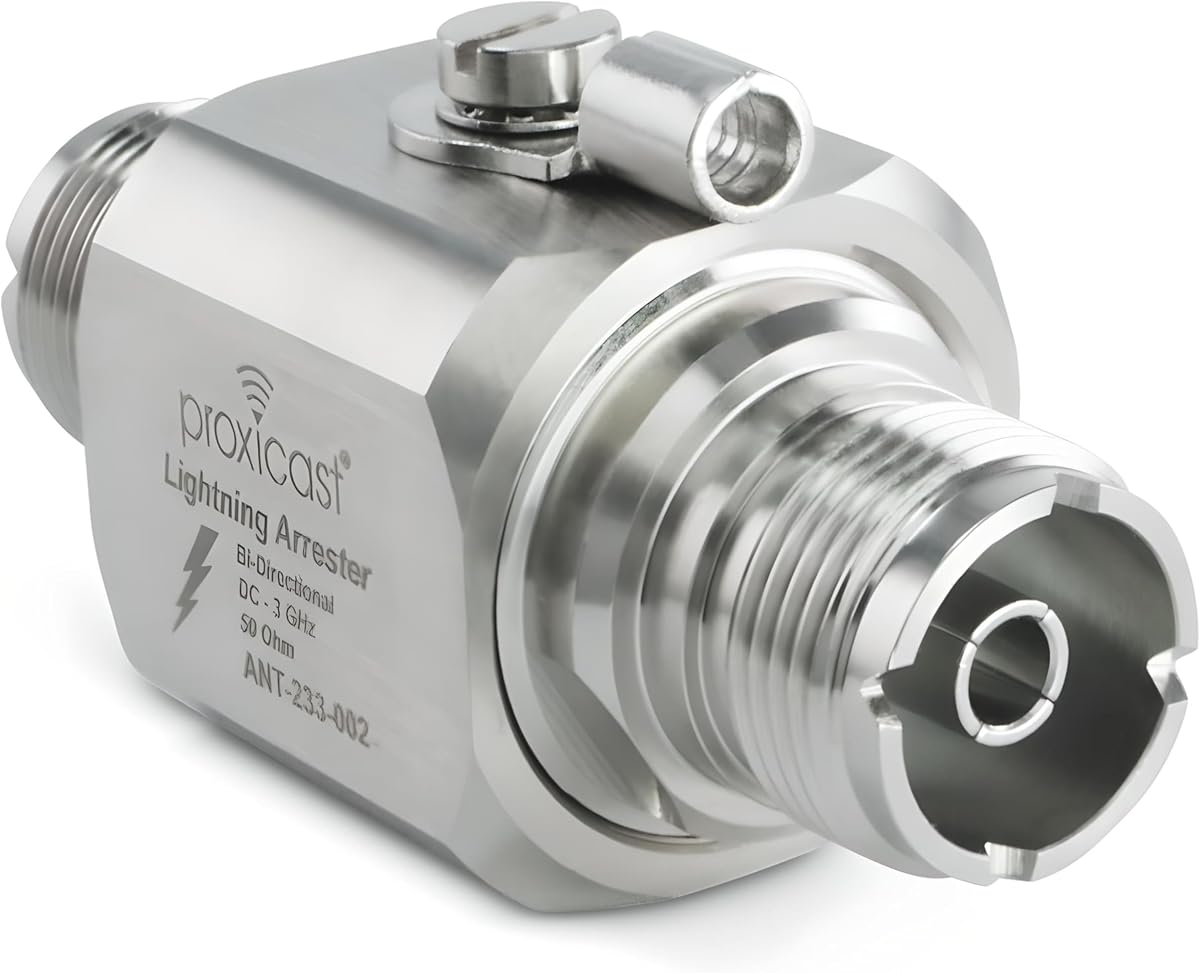
The Proxicast ProGrade 230V Coaxial Lightning Arrester offers strong protection with a 230V gas discharge tube capable of handling multiple strikes. It is designed for VHF and UHF ham radio equipment needing reliable coaxial safety.
We may earn a commission when you buy through this link, at no additional cost to you.
Its bi-directional protection ensures safety regardless of signal flow direction. The unit includes DC pass-through which maintains power to any active equipment while the multi-strike capability adds long-term reliability to your installation.
Users should note that it uses SO-239 connectors which may not match all existing cabling without adapters. Proper grounding remains critical to its function so ensure you connect the ground wire securely to a certified earth point.
This arrester suits operators with outdoor antennas or base stations needing durable protection. Its weather-resistant build makes it suitable for permanent installations exposed to rain or extreme temperature changes.
The gas tube design allows multiple strikes to be absorbed without failing immediately giving you more time before replacement.
It allows DC current to pass through so your powered antenna components remain functional even during a storm surge.
We may earn a commission when you buy through this link, at no additional cost to you.
The Proxicast Prograde Lightning Arrestor boasts a perfect 5.0 rating from users who appreciate its sturdy aluminum housing and reliable performance. It is engineered specifically for coaxial cables with UHF interfaces to deliver strong defense.
We may earn a commission when you buy through this link, at no additional cost to you.
Its internal protective components react instantly to surges and do not require fuse replacements which adds to convenience. The aluminum housing offers excellent heat dissipation helping to maintain consistent performance even after multiple electrical discharges.
While the package includes an earth lead you must still ensure it is securely connected to a proper grounding terminal for the device to function safely during storm events. This attention to grounding is essential for effective surge diversion.
This model is excellent for CB and Ham radio operators seeking hassle-free protection. Its plug and play design makes it easy to insert into existing feedlines without modifying your current setup.
The aluminum housing dissipates heat effectively which helps preserve internal components after high-energy discharge events.
Unlike older designs this unit has no fuses to replace reducing maintenance needs and improving operational uptime.
We may earn a commission when you buy through this link, at no additional cost to you.
The Diamond Antenna SP3000 sets a high standard for premium surge protection with its wide DC to 3000MHz frequency range. Its 4.8 rating indicates consistent satisfaction among users who demand high-quality components for their stations.
We may earn a commission when you buy through this link, at no additional cost to you.
Featuring N-Type female connectors it supports higher power applications up to 200W while maintaining low loss and high isolation. This makes it ideal for modern setups that might use wideband signals or higher frequency antennas.
While it comes at a higher price than basic models the extended frequency range and robust construction justify the investment for serious operators. It is particularly well suited for advanced installations requiring maximum reliability.
Choose this model if you need to protect equipment operating at higher frequencies or power levels. Ensure your antenna system uses N-Type connectors or budget for appropriate adapters to maintain a secure low-loss connection.
Its range up to 3GHz ensures compatibility with modern wideband antennas and advanced digital communication modes.
Designed to handle up to 200W it protects high-power transmitters from damage during unexpected lightning strikes.
We may earn a commission when you buy through this link, at no additional cost to you.
The XRDS-RF Bulkhead Arrestor offers a unique advantage with its ability to mount directly through an enclosure wall. This feature makes it ideal for protecting equipment inside shielded boxes or outdoor cabinets.
We may earn a commission when you buy through this link, at no additional cost to you.
Its construction includes an integrated nut and sufficient thread depth to allow secure installation through copper strips or metal enclosures. The design ensures a robust connection while maintaining the low loss and protection of the other units.
Installation requires a hole cut to the exact specification for the bulkhead mount which adds a step compared to inline devices. However for setups requiring physical protection at the entry point this design is highly effective.
Select this model for installations where the cable enters a shielded box or wall. It provides reliable protection and clean routing for coaxial cables in professional or rugged outdoor environments.
The bulkhead design lets you feed coax directly through a metal wall to improve shielding and reduce entry points.
An integrated nut ensures the unit stays tight against the enclosure wall to prevent movement or loosening over time.
We may earn a commission when you buy through this link, at no additional cost to you.
The Coaxial Lightning Arrester 2 Pack provides excellent value by including two units in one order. This is beneficial for multi-antenna systems or keeping a spare unit ready for future upgrades.
We may earn a commission when you buy through this link, at no additional cost to you.
Each unit features brass plated pins for stable signal connection and a PTFE insulator to protect the inner core from environmental damage. The design ensures low VSWR and wide bandwidth performance for reliable operation.
Both units require connection to a ground wire to function effectively. Ensure you install them as close as possible to the equipment entrance to divert surges before they reach sensitive components.
This pack is ideal for operators needing multiple protectors at once. It is a cost-effective solution for maintaining consistent protection across several antennas or stations.
Getting two units in one package saves time and money when protecting multiple antennas or setups.
Brass plated pins and low VSWR help maintain strong signal integrity across various frequencies.
We may earn a commission when you buy through this link, at no additional cost to you.
The RAIGEN Lightning Arrestor covers an impressive 0 to 6GHz range making it ideal for diverse setups including WiFi IoT and Ham radio. Its 4.8 rating reflects its ability to handle modern multi-band requirements effectively.
We may earn a commission when you buy through this link, at no additional cost to you.
It features a replaceable 90V gas discharge tube and a heavy-duty brass nickel-plated body for durability. With less than 0.1dB insertion loss it ensures your signal strength remains high while protecting against surges.
Users should note that the ground cable is not included so you must source a proper grounding wire separately. Proper installation is critical to ensure the surge protection works as intended during storm events.
This arrester is perfect for hybrid setups using cellular or WiFi alongside radio antennas. It offers broad compatibility and professional-grade protection for serious technical deployments.
Less than 0.1dB insertion loss ensures minimal signal degradation even for high-frequency data and voice transmissions.
A replaceable discharge tube means you can restore protection after a strike without replacing the whole unit.
We may earn a commission when you buy through this link, at no additional cost to you.
The Opek LP-350a Surge Protector offers solid protection for CB and Ham radios with up to 350 watts of power handling. Its simple design and wide terminal make it easy to integrate into existing systems.
We may earn a commission when you buy through this link, at no additional cost to you.
Operating across a frequency range of DC to 600MHz it suits lower frequency applications well. The ground terminal is designed to accept various optional cables with PL-259 connectors for flexible installation.
While it lacks modern premium features it provides reliable basic protection for static and lightning-induced surges. Users must ensure a robust ground connection for full effectiveness in storm conditions.
This protector is a practical choice for operators who need a straightforward solution for standard setups. It combines reliable protection with simple usability for everyday amateur radio needs.
Handling up to 350 watts ensures it can protect higher power transmitters from surge damage effectively.
A wide ground terminal accepts various grounding cables for easier adaptation to different ground systems.
We may earn a commission when you buy through this link, at no additional cost to you.
Selecting the right surge protector involves understanding your equipment needs and environmental factors. Below are the key specifications to evaluate before making a purchase.
Ensure the arrester matches the connectors on your coaxial cables and transceiver. Common types include PL-259 SO-239 and N-Type. Using mismatched connectors can lead to signal loss or loose connections.
Always check the connector gender (male or female) on both ends of the arrester to ensure it fits inline with your existing cable run.
Verify that the arrester covers the frequencies you operate. Basic units cover up to 500MHz or 600MHz while premium models may extend to 3GHz or higher for modern setups.
Select a unit with a range that fully encompasses your operating band to avoid signal attenuation or poor performance.
Look for low insertion loss to maintain signal strength. Units with loss under 0.4dB are generally preferred as they minimize signal degradation over the transmission line.
Lower insertion loss ensures that your transmitted signal remains strong and your received signal is clear.
Higher discharge capacity means better protection against strong surges. Units rated for thousands of amps offer more robust defense during severe thunderstorms.
Choose a model with high impulse capacity to protect valuable equipment from damaging lightning strikes.
Proper grounding is essential for any lightning arrestor to function. Ensure the unit has a dedicated ground screw or lug and that you have a proper path to earth ground.
Connect the arrester as close to the building entrance as possible to divert surges before they enter your shelter.
Outdoor installations require weather-resistant materials like nickel-plated brass or aluminum. This prevents corrosion that could lead to failure over time.
Opt for units designed for outdoor exposure to ensure long-term reliability in harsh conditions.
Some models feature replaceable surge elements which allow you to reset protection after a major strike without buying a new unit.
Consider this feature if you operate in areas with frequent storms to save money and reduce downtime.
Choose between inline mounts for coax runs or bulkhead mounts for entry through walls or enclosures.
Bulkhead units can simplify routing and provide better shielding for equipment inside a box or cabinet.
Install the lightning arrestor between your outdoor antenna feedline and your indoor radio equipment. Ensure you disconnect the antenna and radio before beginning any wiring work to avoid accidental shorts.
Connect a heavy-gauge ground wire from the arrester's ground terminal to a proper earth ground rod. This path must be as short and straight as possible to effectively divert lightning energy.
Inspect the arrester and connections annually for signs of corrosion or damage. If the unit shows signs of wear or has survived a major storm check it closely or consider replacement to maintain safety.
While a lightning arrestor significantly reduces the risk of damage it cannot guarantee total protection in all scenarios. It diverts the majority of surge energy to ground but direct strikes can still overwhelm even the best protectors.
No it is unsafe to work on antenna systems during active storm conditions. Always wait for calm weather to ensure personal safety while installing or repairing lightning protection gear.
Some models are designed to reset and continue working after minor surges while others may require replacement. Check the product manual to see if the unit is rated for multiple strikes.
The best location is as close as possible to the point where the coaxial cable enters your building. This ensures that surges are diverted outside before they reach your indoor equipment.
High-quality arresters with low insertion loss will have a negligible effect on your signal. Units with loss under 0.5dB typically maintain clear and strong transmission and reception.
Use a heavy-gauge copper or copper-clad steel wire like 10-gauge or thicker. A solid path to a dedicated ground rod helps ensure the surge energy dissipates safely.
While not strictly required by law it is highly recommended for all outdoor antennas. It protects expensive equipment and enhances overall safety for your station and home.
Each antenna feedline should have its own dedicated arrestor for best protection. Using a single unit for multiple lines may dilute effectiveness and increase risk for your equipment.
Choosing the right protection helps safeguard your equipment from costly lightning damage. Our top picks cover various needs from budget-friendly options to premium high-performance arrestors.
Prioritize proper grounding and quality components to ensure long-term reliability. A good arrester combined with solid installation practices keeps your station safe year after year.
Check current product details before purchase since features and availability may change. Investing in a reliable surge protector now saves money and hassle in the future.