
STEM Electric Circuit Kit, Electricity Science Project Light Bulb Experiments
4.5Editor score
8 fun circuit experiments included
Includes detailed circuit book guide
Ideal for ages 8 to 14
This guide compares the top electricity learning kits for students and hobbyists, evaluating project variety, safety features, and educational value to help
Electricity learning kits offer a hands-on way to explore the fundamental principles of electrical engineering and physics. These educational tools allow students and hobbyists to build real circuits, understand energy flow, and experiment with magnetism in a safe environment. Choosing the right kit depends on age appropriateness, project complexity, and the depth of instructional material provided.
We compared ten top-rated electricity learning kits based on their component quality, variety of experiments, and educational value. Each product was evaluated for safety features, ease of assembly, and the clarity of instructions. Our analysis focuses on kits that encourage critical thinking and provide a solid foundation for understanding how electrical systems work in the real world.
Each pick in this list highlights specific strengths such as budget-friendly options, advanced physics experiments, or award-winning educational design. You will find detailed breakdowns of what each kit includes and how it supports STEM learning goals. Please note that product availability and pricing may change, so verify current details before making a purchase decision.
4.5Editor score

4.7Editor score

4.5Editor score
The following table provides a side-by-side comparison of all ten selected electricity learning kits. It highlights key specifications such as the number of components, target age groups, and unique features to help you quickly identify the best fit for your needs.



This National Geographic kit stands out as a top choice for families seeking a comprehensive introduction to electricity. With over 120 projects, it offers immense value and longevity for curious minds. The high rating reflects user satisfaction with the ease of use and educational depth provided by the components.
We may earn a commission when you buy through this link, at no additional cost to you.
The standout quality is the sheer number of activities ranging from light shows to sound systems. Components connect easily without tools, ensuring kids can focus on learning rather than struggle with assembly. Video instructions accessible via QR code add a modern touch that aids independent learning effectively.
While the price is higher than entry-level kits, the durability and variety justify the investment. Some users note batteries are sold separately which is standard for safety but adds to the initial cost. These trade-offs are acceptable given the robust build quality and extensive project library available.
This kit is ideal for children aged 8 and up who want to explore electrical engineering in a safe way. Parents looking for a gift that combines fun with serious STEM education will find this option compelling. It remains a strong recommendation for those prioritizing engagement and learning outcomes.
Over 120 projects ensure long-term engagement and repeated learning opportunities for young scientists.
Components are designed for safety with snap connections that eliminate the need for soldering or tools.
We may earn a commission when you buy through this link, at no additional cost to you.
This STEM kit offers an excellent entry point for those on a budget who still want quality educational content. It focuses on core concepts like series and parallel circuits with clear experiments. The rating indicates that users find it effective for teaching basics without overwhelming complexity or cost.
We may earn a commission when you buy through this link, at no additional cost to you.
The included circuit book is a key strength providing guided learning paths for beginners. Projects like the fruit battery make abstract concepts tangible and fun for students. Instructions are designed to be easy to follow encouraging critical thinking and problem solving skills in young learners.
Limitations include a smaller number of experiments compared to higher-priced options. Some users may want more variety as skills progress. However for the cost these trade-offs are reasonable for a starter set intended to build foundational knowledge and interest.
Ideal for parents or teachers seeking an affordable tool for science fairs or home learning. This kit works well for ages 8 to 14 introducing electrical engineering concepts effectively. It is a practical choice for those prioritizing value and essential STEM skills.
The detailed circuit book ensures students follow a structured approach to understanding electrical principles effectively.
Real-world projects like fruit batteries help children visualize how energy can be generated from everyday materials.
We may earn a commission when you buy through this link, at no additional cost to you.
The EUDAX School Physics Labs kit is designed for high school students needing a rigorous understanding of physics principles. It covers both electricity and magnetism offering a comprehensive educational experience. The rating reflects approval from users seeking deeper technical knowledge beyond basic circuit building.
We may earn a commission when you buy through this link, at no additional cost to you.
Full-color manuals provide detailed explanations of principles like Ohm's law and electromagnetic force. Components are specifically chosen to support experiments such as measuring unknown resistors and building hand crank generators. Repair tools included ensure longevity making this a durable option for serious learners.
The focus on high school level material may be too advanced for younger children. Some users note that batteries are not included which adds to the setup cost. These factors are acceptable trade-offs for a kit aiming to support advanced STEM education goals effectively.
Recommended for grades 9 to 11 studying physics or engineering. Teachers and homeschoolers will appreciate the alignment with academic standards. This kit is best for those ready to explore the theoretical aspects of electrical systems in depth.
Experiments cover complex topics like Ohm's law and electromagnetic force suitable for high school curricula.
Full-color guides offer step-by-step instructions and theoretical background to deepen student understanding.
We may earn a commission when you buy through this link, at no additional cost to you.
This Mysterystone kit offers a robust bundle for electricity and magnetism learning with unique components not always found in standard sets. It includes items like magnetic switches and LED controls allowing for interesting experiments. The rating shows users value the educational depth and organization of the kit.
We may earn a commission when you buy through this link, at no additional cost to you.
The manual stands out by explaining the why behind experiments not just the how. Students are encouraged to discover and think beyond the 50 suggested projects. All items have fixed places in the storage case making setup and cleanup convenient for classroom use.
The depth of content might be challenging for very young children without adult supervision. Some users find the manual dense but appreciate the clarity it provides for advanced learners. These minor hurdles are balanced by the high quality of components and educational value provided.
Ideal for students interested in physics who want to explore beyond basic circuits. Teachers can use this to demonstrate specific concepts like Joule's first law effectively. It serves well as a comprehensive resource for dedicated learners looking for variety.
Features like magnetic switches and LED control modules allow for diverse and engaging experiment possibilities.
The manual explains scientific principles deeply encouraging critical thinking and conceptual understanding.
We may earn a commission when you buy through this link, at no additional cost to you.
This Sntieecr kit focuses on introducing motors and sound within electrical circuits making it fun for kinetic learners. It includes two motors and multiple propellers allowing children to build moving projects. The rating suggests it is effective for basic engineering tasks though with some safety caveats.
We may earn a commission when you buy through this link, at no additional cost to you.
Components like buzzers and propellers help children understand how electrical energy converts to motion and sound. Instructions are straightforward making it easy to assemble for school STEM projects. The affordable price makes it accessible for those wanting to add motors to their collection.
A warning indicates that using 3V for too long can cause heat or short circuits requiring careful monitoring. The kit is limited in variety compared to broader sets focusing mainly on motor and sound components. These factors are manageable with proper supervision and time limits.
Best for children aged 8 and up interested in mechanical aspects of electricity. Parents should supervise sessions to prevent overheating during extended use. This kit is a practical addition for those wanting to explore motion and sound in simple circuits.
Motors and propellers provide a tangible way to study how electricity powers mechanical movement and sound.
Users must control voltage usage time to prevent heat buildup and potential short circuits.
We may earn a commission when you buy through this link, at no additional cost to you.
This Teenii kit is designed to encourage family science activities with a wide range of components. It includes 50 pieces covering circuits and magnetism suitable for ages 8 and up. The rating reflects user satisfaction with the durability and educational value of the set.
We may earn a commission when you buy through this link, at no additional cost to you.
The manual is 40 pages long with full-color diagrams guiding users through experiments. Components like voltmeters and motors allow for precise measurements and practical applications. Parents appreciate how it fosters curiosity and critical thinking through shared learning experiences.
The text-heavy manual might require reading assistance for younger children. Some users note the need for batteries which adds to the initial setup cost. These are minor drawbacks considering the comprehensive nature of the kit and its suitability for group learning.
Ideal for families wanting to engage in science projects together. Teachers may also find it useful for group activities due to its component variety. This kit is a solid choice for those prioritizing interaction and educational growth.
Designed for parent-child discovery activities that foster teamwork and shared scientific exploration.
Includes voltmeters and ammeters allowing students to measure and understand electrical properties accurately.
We may earn a commission when you buy through this link, at no additional cost to you.
This Physics Labs kit provides a robust set of components for high school level electrical learning. It includes unique items like sensitive ammeters and magnetic switches that enhance experimental possibilities. The rating indicates strong performance for students needing reliable educational tools.
We may earn a commission when you buy through this link, at no additional cost to you.
The double-layer storage box ensures items are organized and protected during transport. Manuals explain operation steps clearly guiding students through discovery and exploration. This structure supports both independent study and group work in classroom settings effectively.
The focus on high school curriculum may limit use for younger learners without modification. Some users note that batteries are required but not included which is standard but adds cost. These factors are acceptable for those needing advanced materials for structured learning.
Recommended for grades 9 to 11 or for teachers managing science labs. The storage solution makes it practical for moving between stations or classrooms. This kit is best for those needing detailed measurement tools and durable organization.
Inclusion of sensitive ammeters allows students to make precise measurements and deepen their understanding of current.
The sturdy double-layer storage box keeps components secure and organized for repeated use in various environments.
We may earn a commission when you buy through this link, at no additional cost to you.
The EUDAX Basic Kit is an excellent starting point for younger students learning about series and parallel circuits. It emphasizes simplicity and clear English instructions making assembly straightforward. The rating reflects high satisfaction from users who find it effective for consolidating textbook knowledge.
We may earn a commission when you buy through this link, at no additional cost to you.
Components are designed to help students understand basic current rules and improve hands-on ability. The plastic storage box ensures durability and organization for repeated use at school or home. This focus on fundamentals makes it a reliable tool for early STEM education.
The kit offers limited complexity which may become repetitive for advanced learners. Users note that batteries are not included which is a minor inconvenience for immediate setup. These limitations are reasonable for a product designed specifically as an introductory educational tool.
Ideal for grades 7 to 9 studying science basics or preparing for fairs. Teachers can use it to reinforce textbook concepts through practical application. This kit is a solid choice for those seeking simplicity and clarity in learning materials.
Focuses on essential series and parallel circuit building to strengthen basic understanding of electrical rules.
English manual provides straightforward guidance making assembly accessible for younger students.
We may earn a commission when you buy through this link, at no additional cost to you.
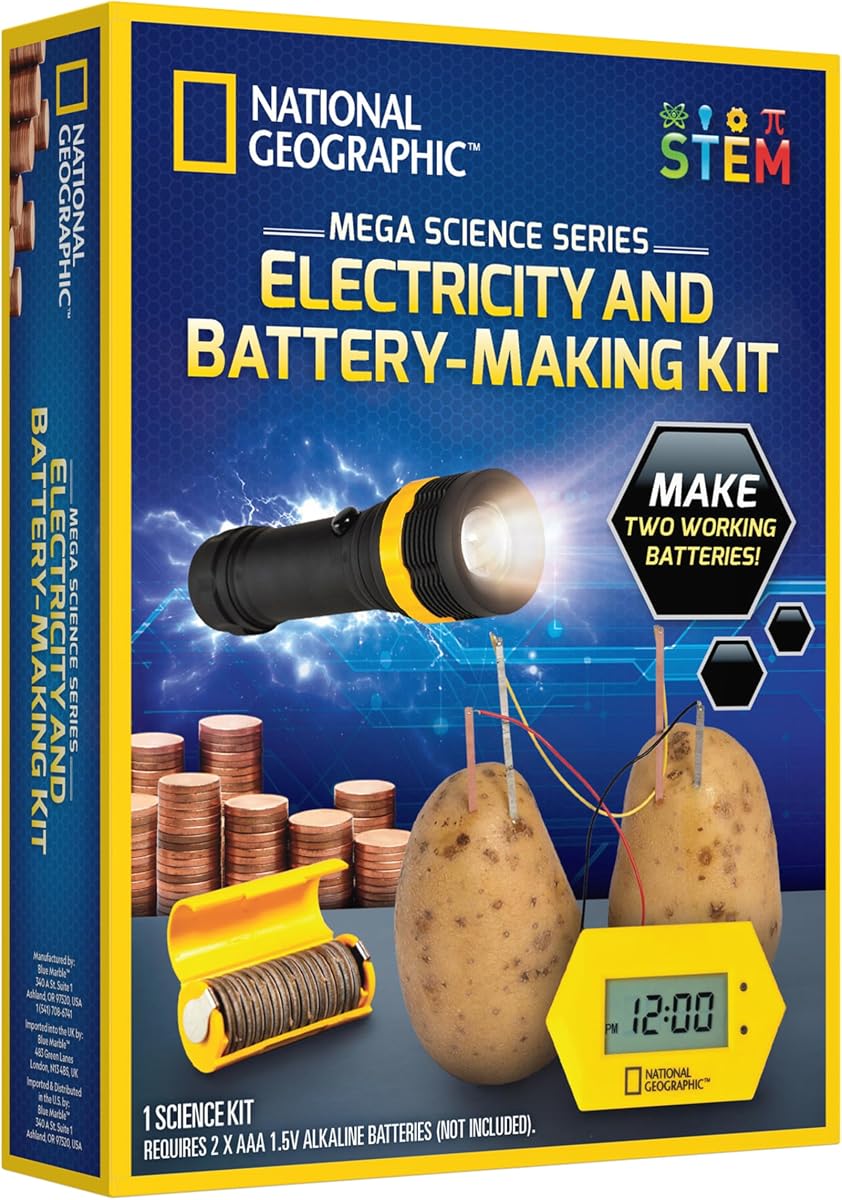
This National Geographic kit focuses specifically on battery science with engaging projects like the potato clock and coin flashlight. It teaches how batteries function through hands-on construction and measurement. The rating indicates strong approval from users interested in energy generation basics.
We may earn a commission when you buy through this link, at no additional cost to you.
Experiments include building a potato clock with a voltmeter and constructing a coin-powered flashlight. Detailed guides provide insight into why these circuits work deepening conceptual understanding. The simplicity of the projects makes them accessible for various age groups.
The kit includes only two projects which may limit long-term engagement compared to larger sets. Users may need to source additional food items like potatoes which varies by availability. These factors are acceptable for a specialized tool designed to teach battery principles specifically.
Ideal for students wanting to understand energy sources and circuit completion. Parents and teachers can use this to supplement broader electricity units with specific battery labs. This kit is a great addition for those prioritizing energy generation education.
Projects allow kids to build their own batteries and see how chemical energy converts to electricity.
Includes a voltmeter to measure output providing practical experience with scientific instruments.
We may earn a commission when you buy through this link, at no additional cost to you.
This upgrade kit expands on basic concepts with more complex projects like traffic lights and wind power cars. It includes LEDs and switches allowing for advanced circuit design and control. The rating suggests it is effective for older students needing more challenge than basic kits.
We may earn a commission when you buy through this link, at no additional cost to you.
Projects like the stair double switch circuit teach practical wiring used in homes and buildings. The transparent storage box makes it easy to view contents and organize components. Full-color manuals guide students through these advanced topics effectively.
Some users may find the setup requires careful preparation of batteries and components. The complexity may be too high for children under 7 without adult help. These factors are acceptable for a kit designed to push learners toward more advanced engineering tasks.
Ideal for grades 7 to 11 seeking advanced project variety and real-world applications. Teachers can use it to demonstrate control systems like double switches. This kit is best for those looking to extend their circuit building capabilities.
Projects like traffic lights and double switches mirror real-world wiring systems providing practical context.
Inclusion of LEDs and wind power models adds visual and mechanical interest to electrical experiments.
We may earn a commission when you buy through this link, at no additional cost to you.
Selecting the right electricity learning kit depends on several key factors that align with your educational goals and the user's age. This guide breaks down the essential considerations to help you make an informed decision.
Different kits are designed for specific age groups ranging from elementary school to high school. Younger learners benefit from snap-together components with clear visuals while older students need more technical components like ammeters. Checking the recommended grade level ensures the child has the dexterity and cognitive skills to engage safely.
Always verify the age recommendation to match the child's development level and safety needs.
The number of projects available determines how long a child will stay interested in the kit. Kits with over 100 projects offer more value and learning opportunities compared to those with fewer than 10. Look for kits that include diverse experiments like motors, lights, and sound to keep things engaging.
Choose a kit with a broad project range to sustain long-term engagement and learning.
High-quality components such as durable wires, solid connectors, and proper insulation are essential for safety and longevity. Kits with plastic snaps are easier to manage than those requiring screwdrivers or soldering tools. Inspect reviews for feedback on material durability to ensure the kit withstands repeated use.
Prioritize durable components that ensure safety and withstand repeated use by students.
Clear instructions are crucial for independent learning and preventing frustration. Full-color manuals with diagrams help students visualize connections and understand the why behind each step. Video tutorials via QR codes can provide additional support for visual learners who prefer watching the process.
Look for manuals with diagrams and video support to ensure a smooth learning experience.
Safety is paramount when working with electricity. Good kits include low voltage components that minimize the risk of burns or shocks. Some kits include warning labels about heat generation or short circuits which should be reviewed before use. Ensure the kit meets relevant safety standards for children's toys.
Select kits with low-voltage components and clear safety warnings to protect the child.
Some kits focus on basic circuits while others delve into physics principles like Ohm's law or magnetism. Consider whether the child needs a simple introduction or a deeper theoretical understanding. Advanced kits may include tools like voltmeters that teach measurement skills essential for scientific study.
Choose a kit depth that matches the learner's current knowledge and future goals.
A well-organized kit makes setup and cleanup easier. Storage boxes with fixed slots prevent parts from getting lost and allow for quick access. Transparent cases are helpful for seeing what is inside without opening the box. Good organization encourages consistent use and reduces frustration.
Opt for kits with structured storage cases to maintain organization and ease of access.
Price varies significantly based on the number of components and educational depth. While expensive kits may offer more projects, affordable options can still provide excellent foundational learning. Calculate the cost per project to determine the true value and compare against similar options in the market.
Compare cost per project to find the best value that fits your financial constraints.
Begin by reading the manual thoroughly to understand the components and safety instructions. Organize parts using the provided storage case to ensure everything is ready for assembly. Start with the simplest projects to build confidence before moving on to complex circuits.
Always check battery connections carefully to avoid short circuits or overheating. Use only the recommended voltage and replace old batteries immediately to maintain performance. If a component gets warm during use, disconnect it immediately to prevent damage or injury.
Store the kit in a cool dry place away from direct sunlight to preserve plastic components. Keep the manual accessible so children can reference it when designing their own circuits. Regularly inspect wires and connectors for wear and replace any damaged parts to ensure safety.
Most of the kits listed do not include batteries for safety and regulatory reasons. You will typically need to purchase AA batteries separately for these experiments. Always check the product description to confirm the number of batteries required before purchasing.
Yes, most kits are designed with safety in mind using low voltage components. However, adult supervision is recommended to prevent misuse or heat buildup from short circuits. Always follow the age recommendations to ensure the child is ready for the tasks.
Absolutely, these kits are popular tools for science fairs and classroom demonstrations. The clear instructions and diverse projects make them suitable for group work and presentations. Teachers often use them to introduce physics concepts in an interactive way.
Basic kits focus on simple series and parallel circuits with visual feedback like lights. Advanced kits include measurement tools like ammeters and complex projects like wind power cars. Choose based on the student's current knowledge level and learning goals.
Most kits come with storage cases designed to organize components neatly. Use dividers or small containers if parts are loose to prevent loss. Labeling sections can help children return items correctly after each experiment session.
Yes, standard components like wires, bulbs, and motors can often be purchased separately. This allows you to create custom circuits beyond the manual's instructions. Check that any added parts match the voltage and connector types of your kit.
Many modern kits include QR codes that link to video instructions and PDF manuals. This digital access helps users troubleshoot issues quickly and visually. Always check the product details for links to online support resources before starting.
Always use the recommended voltage to prevent overheating and burns. Do not mix old and new batteries or different battery types to avoid leaks. Supervise children closely during use to ensure they follow safe assembly and disconnection practices.
We explored ten top electricity learning kits ranging from budget-friendly basics to advanced physics sets. The National Geographic Circuit Kit stands out for its volume of projects while EUDAX offers depth for high school students. Selecting the right one depends on the learner's age and educational objectives.
Prioritize kits that balance component quality with clear instructions to maximize engagement. Safety features and storage organization also play a vital role in long-term usability. Investing in a kit that matches the child's skill level ensures a rewarding learning experience.
Prices and availability for these educational tools change frequently. Verify current details and stock levels directly on the product pages before buying. With the right kit, students can unlock a deeper understanding of the electrical world around them.