
Yxk Zero1 2-Bay Desktop NAS
4.4Editor score
2.5GbE connectivity for fast transfers
Docker support for advanced users
Compact whisper-quiet design
This guide compares the top 10 diskless NAS enclosures for home and office use, evaluating performance, storage capacity, and security features to help you
Finding the right storage solution is essential for modern digital life. A diskless NAS enclosure allows you to build a custom private cloud without pre-installed drives. This flexibility helps you select hard drives that match your specific capacity and speed requirements exactly.
We evaluated ten top-rated diskless NAS enclosures based on performance, reliability, and feature sets. Our analysis covers everything from basic home storage to advanced business-grade solutions. Each product was reviewed for network connectivity, drive compatibility, and ease of use.
Every selection below highlights key strengths and potential limitations for different user needs. Please note that prices and availability can change frequently. We recommend checking current listings before making your final purchase decision to ensure you get the best value available today.
4.4Editor score

4.6Editor score

4.6Editor score
The following table provides a side-by-side comparison of all ten diskless NAS enclosures. It highlights critical specifications such as drive bay count, network speed, and processor type to help you quickly identify the model that fits your infrastructure requirements.




The Synology 2-Bay DiskStation DS223j stands out as a top contender for home users seeking reliable private cloud storage. With a 4.6 rating from users, it offers a seamless experience right out of the box. Its diskless design allows you to choose your own drives, giving you full control over storage capacity and performance.
We may earn a commission when you buy through this link, at no additional cost to you.
This model excels in software support and ease of use. The DSM operating system provides a user-friendly interface that simplifies file management, sharing, and backup tasks. Users can easily access files from anywhere using the QuickConnect feature. The integrated surveillance center supports multiple IP cameras, making it a versatile hub for home security and data storage.
While the Gigabit network limitation might be a constraint for high-speed workflows, it remains sufficient for most home applications. The lack of NVMe slots means you cannot use SSDs for caching or system booting to boost performance significantly. However, for general file storage and media streaming, these trade-offs are acceptable for the price and reliability offered.
Home users and small office environments should consider this unit for its balance of features and simplicity. It is ideal for those who want a set-and-forget solution without complex configuration. We recommend this model for anyone prioritizing software stability and ease of use over raw network speed.
Synology DS file allows you to access your files from any device with internet connectivity. You can easily share large files with clients or family without worrying about email attachment limits.
With Synology Active Backup for Business and Time Machine support, you can protect data from multiple computers. This automated approach ensures your critical files are always safe from hardware failure or accidental deletion.
We may earn a commission when you buy through this link, at no additional cost to you.
The TERRAMASTER D8 Hybrid is a unique offering designed for users needing massive external storage with high-speed access. Rated highly by users, it supports four HDDs and four NVMe SSDs simultaneously. This configuration allows you to balance cost-effective bulk storage with lightning-fast performance for active projects.
We may earn a commission when you buy through this link, at no additional cost to you.
Performance is a standout feature with USB 3.2 Gen2 supporting up to 10Gbps speeds. Users report transfer speeds reaching over 1000 MB/s with M.2 SSDs. The TPM power management technology ensures efficient energy use while keeping drives active when needed. This makes it excellent for video editors who need fast access to large files.
The lack of built-in hardware RAID means you rely on software RAID or independent drives. While this offers flexibility, it requires more management compared to NAS systems with integrated RAID. Additionally, it depends on your computer for power and processing, so it is not a standalone server solution for remote access.
Creative professionals and power users will appreciate the versatility of this enclosure. It serves as an ideal external DAS for expanding your workstation storage. We recommend it for those who need portable, high-speed storage without the complexity of a full NAS setup.
You can mix and match drive types to optimize your storage strategy. Use HDDs for archival content and SSDs for active project files to maximize efficiency without sacrificing capacity.
The USB-C interface supports rapid file transfers essential for modern workflows. Large video files can be moved in seconds, significantly reducing wait times during editing sessions.
We may earn a commission when you buy through this link, at no additional cost to you.
The Yxk Zero1 offers an impressive entry point into the world of private cloud storage. With a solid user rating, it brings essential NAS features to a budget-friendly package. Its diskless design ensures you only pay for the hardware and drives you need, avoiding unnecessary pre-installed costs.
We may earn a commission when you buy through this link, at no additional cost to you.
A key advantage is the inclusion of 2.5GbE networking, which is rare at this price point. This allows for faster file transfers compared to standard Gigabit Ethernet. Additionally, Docker support enables tech-savvy users to run custom applications, adding functionality beyond basic file storage and sharing.
The trade-off lies in its processing power and software ecosystem. It may struggle with heavy multitasking or complex applications compared to premium models. The software interface is straightforward but lacks the depth of larger brands. However, for basic storage needs, these limitations are often acceptable.
Beginners and budget-conscious users will find this NAS ideal for starting their private cloud journey. It is perfect for photo backups and basic media streaming. We recommend this model for anyone seeking affordable, fast networking in a compact package.
The 2.5GbE port ensures you can utilize faster routers without upgrading your NAS hardware immediately. This future-proofs your investment and speeds up local file access.
Docker support allows you to run home automation tools or media servers. This flexibility transforms the device from simple storage into a multifunctional home server.
We may earn a commission when you buy through this link, at no additional cost to you.
The UGREEN DXP4800 GT is a powerful workstation designed for creators and demanding home office users. With an AMD Ryzen processor and dual 10GbE ports, it delivers exceptional throughput for large file transfers. The diskless option lets you tailor storage capacity to your specific needs without paying for unused space.
We may earn a commission when you buy through this link, at no additional cost to you.
Performance is unmatched in its class with support for 64GB RAM and high-speed SSD expansion. This makes it capable of running virtual machines and Docker containers smoothly. The UG Pro OS provides an intuitive interface with built-in features like a surveillance center and media management tools for seamless operation.
The high cost may be a barrier for casual users who do not need 10GbE speeds. Additionally, while ECC RAM is supported, it requires a specific upgrade path. However, for professionals needing speed and reliability, these factors are justified by the performance gains offered.
Power users, video editors, and small business teams should consider this unit. It serves as a robust central hub for all digital assets. We recommend this model for those prioritizing performance and expandability in their storage infrastructure.
Dual 10GbE ports allow for multi-gigabit throughput when used with a compatible switch. This enables multiple users to access files simultaneously without lag.
Built-in apps cover everything from backups to media streaming. The ecosystem is designed to simplify management and enhance productivity for both home and office users.
We may earn a commission when you buy through this link, at no additional cost to you.
The QNAP TR-004 serves as an excellent expansion unit for existing QNAP NAS systems. With hardware RAID support, it offers data protection options that software RAID often lacks. The diskless design allows you to populate it with compatible drives to increase your storage pool seamlessly.
We may earn a commission when you buy through this link, at no additional cost to you.
Its USB Type-C connection ensures fast data transfer speeds compatible with modern computers. Users can utilize this as external storage for backups or expand their NAS capacity without network latency. The hardware RAID capabilities ensure redundancy is handled by the enclosure itself, reducing load on the main NAS.
Limitations include dependency on QNAP systems for full functionality. It does not function as a standalone network server and relies on a host device for access. This restricts its use case compared to full NAS units, but it excels within its specific niche.
QNAP NAS owners looking to expand capacity should consider this unit. It is ideal for adding bulk storage with hardware protection. We recommend it for existing QNAP users needing an easy storage expansion solution.
Built-in RAID support protects your data from drive failures independently. This ensures data integrity even if the main system is offline.
You can add this unit to an existing NAS to increase capacity. It integrates smoothly with QNAP systems allowing you to grow your storage as needed.
We may earn a commission when you buy through this link, at no additional cost to you.
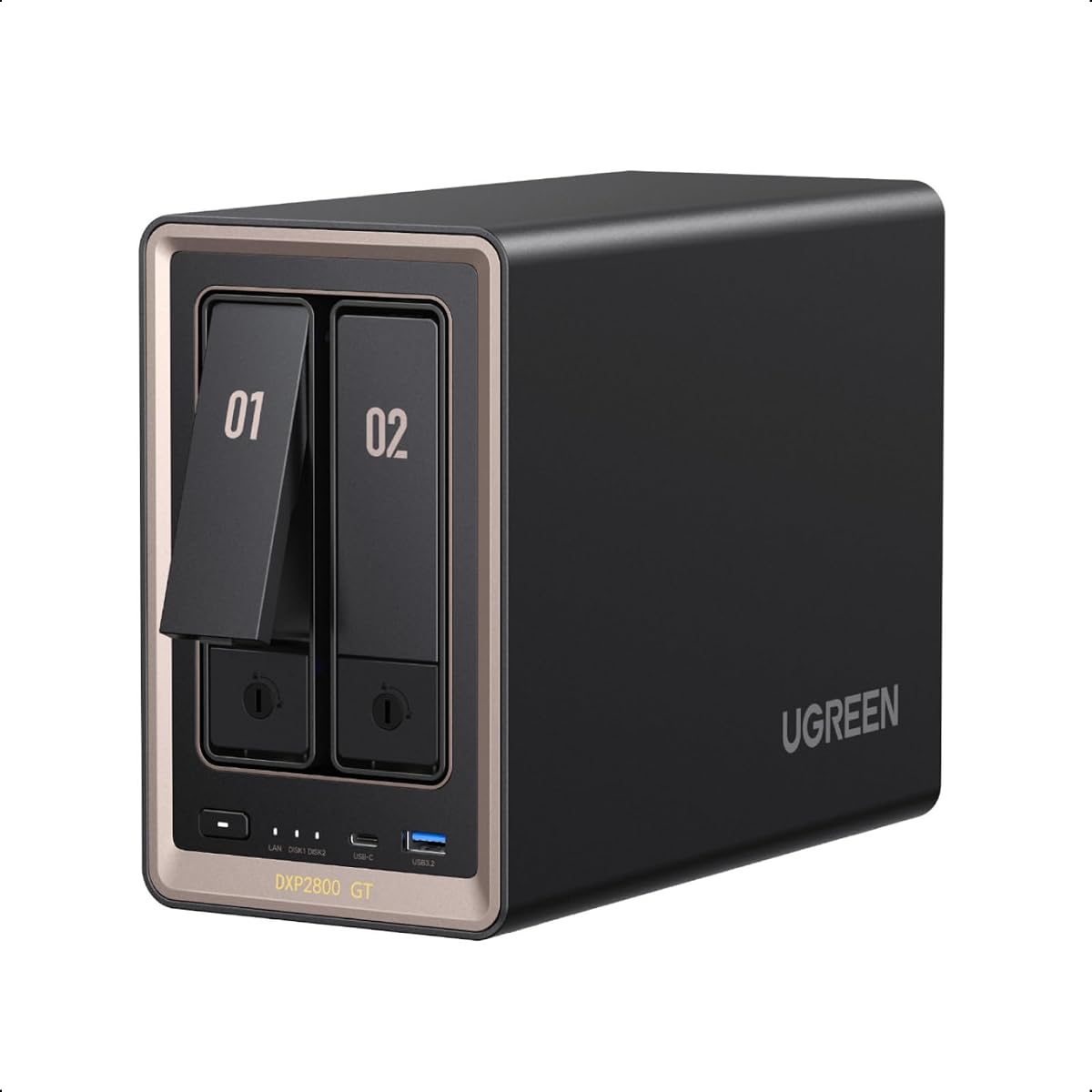
The UGREEN DXP2800 GT brings premium features to a 2-bay form factor. With a powerful AMD Ryzen processor and 10GbE networking, it delivers performance usually reserved for larger units. This makes it ideal for freelancers needing fast access to large files in a compact chassis.
We may earn a commission when you buy through this link, at no additional cost to you.
Its capabilities include extensive support for Docker and virtual machines. Users can run multiple applications simultaneously without performance bottlenecks. The surveillance center adds security features allowing you to monitor your home or office directly from the NAS interface.
The limited drive bays restrict total storage capacity compared to 4-bay models. Users must rely on SSD expansion for additional space. Despite this, the raw speed and processing power make it a strong contender for performance-focused users.
Freelancers and solo creatives should look at this model for its speed. It handles heavy workloads better than standard 2-bay units. We recommend this for users prioritizing transfer speeds and app flexibility over drive count.
The 10GbE port ensures files move quickly between your computer and storage. This reduces downtime during editing and rendering tasks significantly.
UGOS Pro allows for a wide range of self-hosted applications. You can run home automation tools or media servers with ease on this powerful hardware.
We may earn a commission when you buy through this link, at no additional cost to you.
The Synology DS925+ is a robust mid-range option for users needing reliable and scalable storage. With dual 2.5GbE ports and a powerful CPU, it offers faster networking than standard models. The diskless design allows for flexibility in drive selection to match your storage goals.
We may earn a commission when you buy through this link, at no additional cost to you.
It supports M.2 SSD caching to boost performance for active datasets. The DSM operating system provides an extensive library of apps for file management, media, and security. This model is a great balance of features and stability for home and small office use.
It lacks built-in NVMe slots for system volume or storage, which limits some performance optimizations. However, M.2 caching is a viable alternative for many users. The reliability of Synology software often outweighs this hardware constraint.
Small business owners and advanced home users should consider this unit. It provides enterprise-grade reliability in a home-friendly package. We recommend it for those wanting a scalable and reliable storage solution.
Dual 2.5GbE ports allow for higher throughput than standard Ethernet. This is ideal for teams sharing large files over the network frequently.
Active Directory and advanced permission controls ensure data safety. You can manage user access levels effectively to protect sensitive information.
We may earn a commission when you buy through this link, at no additional cost to you.
The Synology DS425+ is tailored for teams needing secure and efficient file collaboration. It offers a centralized repository with granular access controls ensuring everyone has appropriate access levels. The diskless design gives IT admins the freedom to choose enterprise-grade drives for reliability.
We may earn a commission when you buy through this link, at no additional cost to you.
Features like audit logs provide transparency on who accessed what data when. This is crucial for compliance and security in small business environments. The 3-year warranty and dedicated support options add peace of mind for business-critical deployments.
The cost and setup complexity might be overkill for single users. It is designed to support concurrent access from multiple users smoothly. However, for teams prioritizing data integrity and control, this model is highly effective.
Business teams and IT administrators should consider this unit for shared storage. It ensures data protection and efficient collaboration. We recommend it for offices requiring centralized and secure file access.
Granular permissions and audit logs help track data access. This ensures your business documents remain secure from unauthorized changes.
The system supports multiple users accessing files simultaneously. This enhances team productivity by removing bottlenecks in file access.
We may earn a commission when you buy through this link, at no additional cost to you.
The Synology DX515 is an expansion unit designed to add five bays to your existing Synology NAS. It offers hot-swappable drive bays allowing maintenance without shutting down the system. This diskless unit gives you the flexibility to choose drives that match your storage needs perfectly.
We may earn a commission when you buy through this link, at no additional cost to you.
Setup is straightforward with DSM tools guiding you through configuration. It integrates seamlessly with your existing volumes to expand capacity easily. This makes it a cost-effective way to increase storage without replacing your primary NAS unit.
It cannot function as a standalone device and depends entirely on a compatible NAS. Users must ensure their primary unit supports expansion. However, for growing storage needs, it is a reliable and efficient solution.
Existing Synology users with expanding storage needs should choose this unit. It offers a simple path to more capacity. We recommend it for those looking to grow their NAS ecosystem efficiently.
You can add five more drives to your existing setup. This significantly increases your total storage without buying a new system.
Hot-swap support allows you to replace drives while the system runs. This ensures continuous availability for your data and users.
We may earn a commission when you buy through this link, at no additional cost to you.
The TrueNAS Mini X+ is a compact enterprise server designed for demanding storage tasks. With ZFS filesystem support and 32GB RAM, it ensures data integrity and performance. The diskless design allows you to configure drives for specific reliability and speed requirements.
We may earn a commission when you buy through this link, at no additional cost to you.
Its hardware includes dual 10GigE ports for ultra-fast network connectivity. This makes it suitable for data centers or advanced home labs. The self-healing ZFS protects against data corruption and provides robust redundancy options out of the box.
The complexity of ZFS may be daunting for average users. It requires more setup knowledge than standard NAS units. However, for those needing top-tier data protection and performance, it is unmatched.
Advanced users and SMBs needing enterprise features should consider this model. It serves as a powerful local cloud solution. We recommend it for users prioritizing data integrity and high performance.
ZFS protects your data from corruption and bit rot. This ensures long-term reliability for your most critical files.
Dual 10GigE ports enable massive data transfers at lightning speed. This is ideal for large-scale file operations and virtualization.
We may earn a commission when you buy through this link, at no additional cost to you.
Selecting the right diskless NAS enclosure involves evaluating several technical factors to ensure it meets your specific storage and performance needs. This guide outlines the key considerations to help you make an informed decision.
The number of drive bays determines your maximum storage capacity and redundancy options. A 2-bay unit is suitable for basic home backup, while 4 or 5 bays allow for RAID configurations that protect against drive failures. Consider your future storage growth when selecting the bay count.
Choose a bay count that accommodates your current data volume and future expansion plans without needing a hardware upgrade.
Network speed is critical for file transfer rates. Standard Gigabit Ethernet is sufficient for most home users, but 2.5GbE or 10GbE is recommended for creative professionals working with large media files. Check if your network switch supports higher speeds to maximize throughput.
Select a model with network ports that match your router or switch capabilities to ensure optimal performance.
The CPU determines how many tasks the NAS can handle simultaneously. Basic models handle simple file sharing, while high-performance CPUs with multiple cores support virtual machines and Docker containers. Ensure the processor is powerful enough for your intended applications.
Opt for a higher-end CPU if you plan to run multiple services like media servers or security monitoring.
The NAS operating system affects usability and feature availability. Brands like Synology and UGREEN offer intuitive interfaces with extensive app ecosystems. Check for support features you need such as surveillance, backup automation, and remote access tools.
Prioritize an OS that offers a user-friendly experience and the specific apps you require for your workflow.
Data security is paramount when storing sensitive files. Look for support for encryption, two-factor authentication, and firewall features. Business units often include audit logs and advanced permission controls to manage user access effectively.
Ensure the NAS provides robust security protocols to protect your data from unauthorized access.
Future expandability allows you to upgrade memory or storage later. Some units support RAM upgrades or M.2 SSD caching to improve performance. Check if the unit supports expansion units if you anticipate needing more drive bays later.
Choose a model with upgrade options to extend the lifespan of your hardware investment.
A reliable warranty and customer support can save you from costly downtime. Look for manufacturers that offer at least a three-year hardware warranty. Support services like online knowledge bases and technical support are valuable for troubleshooting.
Select a brand with a proven track record of support to ensure long-term reliability.
Since NAS units often run 24/7, power consumption matters for electricity costs. Models with energy-efficient CPUs and sleep modes help reduce overhead. Check power ratings to ensure the device fits within your energy budget.
Consider power usage features to keep operational costs low over time.
To begin using your diskless NAS enclosure, insert your hard drives into the drive bays securely. Follow the manufacturer's guide to connect the power and network cables. Once powered on, use the provided setup wizard to initialize the drives and configure your operating system.
Proper maintenance ensures longevity and reliability. Regularly update the firmware to patch security vulnerabilities and improve features. Keep the unit in a well-ventilated area to prevent overheating. Monitor drive health using the built-in tools to catch potential issues early.
Backup your critical data regularly even with RAID protection. While RAID prevents data loss from drive failure, it does not protect against accidental deletion or ransomware. Use cloud backups or external drives for an additional layer of safety.
A diskless NAS enclosure is a network-attached storage device that comes without pre-installed hard drives. It allows users to purchase and install their own drives, offering flexibility in storage capacity and performance. This is ideal for those who want custom configurations.
Yes, diskless models require you to buy hard drives separately. This gives you the freedom to choose specific models that suit your needs. Ensure compatibility with the NAS unit before purchasing drives.
Most modern NAS enclosures support both SSDs and HDDs. SSDs provide faster performance while HDDs offer higher capacity at lower costs. Some units support mixing both types for optimal performance and storage.
Yes, most diskless NAS units support RAID configurations. This allows you to combine drives for data redundancy or increased capacity. Check the specific RAID modes supported by your model to configure it correctly.
You can access files remotely using cloud services or remote desktop features provided by the NAS software. Set up port forwarding or use secure tunneling to access your data from outside your home network.
DAS is directly attached storage connected via USB, while NAS connects over a network. NAS allows multiple users to access files simultaneously over a local or internet network. DAS is typically limited to a single computer.
Yes, most of these enclosures support media server applications like Plex. You can stream your personal media library to various devices. Ensure the CPU is powerful enough to handle transcoding tasks.
We have reviewed ten top-rated diskless NAS enclosures that cater to different needs from basic storage to high-performance computing. Each model offers unique strengths whether it is speed, reliability, or expandability.
When choosing, prioritize your specific use case. Casual users may prefer ease of use while professionals need high-speed networking. Always consider your budget and future growth plans.
Prices and availability fluctuate frequently. Check current listings to ensure you get the best deal before purchasing. We hope this guide helps you find the perfect storage solution.