
Mcbazel 3 in 1 Handheld Digital Anemometer
4.5Editor score
Affordable price point
Backlight LCD display
Wind level Beaufort scale
Discover the top anemometer for measuring wind speed across various applications. This guide compares features accuracy and portability to help you choose the
Finding the right tool to measure air velocity is crucial for professionals and hobbyists alike. A quality anemometer provides accurate data for HVAC systems, sailing, drone flying, and weather monitoring. Choosing the best device ensures reliable readings in diverse environmental conditions.
We have evaluated ten leading handheld models based on accuracy range, ease of use, and additional features like temperature sensing. Each product was selected for its ability to deliver consistent performance across multiple units of measurement. This list covers options for budget-conscious buyers and those seeking premium capabilities.
Each pick in this guide highlights specific strengths such as backlight displays, tripod mounting, or CFM calculation support. Prices and availability may change frequently, so verify current details before purchasing. Our goal is to help you find the wind speed meter that best fits your specific application and budget.
4.5Editor score

4.5Editor score

4.6Editor score
This side by side comparison highlights the key specifications and features of each selected anemometer. Review the data to understand which model offers the best balance of accuracy, durability, and functionality for your specific wind measurement needs.



The BTMETER BT-100 stands out as a reliable tool for both professional HVAC technicians and outdoor enthusiasts. With a solid rating and positive user feedback, it delivers consistent wind speed readings across various environments. Its ability to measure wind temperature and chill adds significant value for safety planning.
We may earn a commission when you buy through this link, at no additional cost to you.
Key strengths include its multifunctional display which shows multiple data points simultaneously. The device supports five different units of measurement making it versatile for international or specific industry standards. The included tripod hole allows for hands free monitoring during drone flights or long distance shooting scenarios.
While it lacks advanced data logging features found in higher end models, the trade-off is a simpler interface and lower cost. The plastic construction is lightweight but feels durable enough for regular field use. Battery life is generally good with auto off features to preserve power.
This model is ideal for anyone needing a straightforward wind meter without complex software requirements. Whether you are checking duct airflow or planning a sailing trip, the BT-100 provides the essential data you need. We recommend it as the top choice for general purpose wind measurement tasks.
Switch between m/s, km/h, ft/min, knots, and mph easily to match your specific application requirements without needing external converters.
The threaded hole on the bottom allows secure attachment to tripods ensuring stable readings during extended monitoring sessions or video recording.
We may earn a commission when you buy through this link, at no additional cost to you.
For those seeking an economical solution, the Mcbazel 3 in 1 offers exceptional value without sacrificing core functionality. It measures wind speed, temperature, and wind level simultaneously making it a comprehensive tool for casual users. The rating reflects high satisfaction among buyers looking for reliable entry level equipment.
We may earn a commission when you buy through this link, at no additional cost to you.
The device stands out for its Beaufort scale display which helps visualize wind force levels quickly. This is particularly useful for sailing or fishing where understanding wind impact is critical. The double-line LCD ensures you see speed and temperature at a glance without switching modes.
While the build is simple, it handles typical outdoor conditions well. The auto power-off feature helps extend battery life which is important given that batteries are not included. The backlight ensures readability in low light conditions like dawn or dusk activities.
We recommend this model for hobbyists or students who need accurate readings without a high price tag. Its simplicity makes it easy to operate even for those unfamiliar with technical wind instruments. It is a practical choice for occasional use or educational purposes.
View wind force levels from 1 to 12 directly on the screen to assess conditions for outdoor activities instantly without mental calculations.
The double-line LCD shows speed and temperature simultaneously ensuring you have all critical data visible at once in any lighting condition.
We may earn a commission when you buy through this link, at no additional cost to you.
The Caldwell Wind Wizard II is designed for users who prioritize durability and long-term reliability in their wind measuring tools. With the highest rating in this lineup, it appeals to hunters and shooters who need consistent data in harsh environments. The premium build quality justifies the higher cost for serious enthusiasts.
We may earn a commission when you buy through this link, at no additional cost to you.
Its water-resistant casing and non-slip rubber design ensure it stays secure even in rainy or windy conditions. The limited lifetime warranty provides peace of mind that the manufacturer stands behind the product's longevity. This focus on resilience makes it ideal for rugged outdoor use.
While it does not offer as many units as some other models, it covers the essential ones like mph, ft/min, km/h, m/s, and knots. The backlight screen is clear and easy to read which is vital when taking quick shots or checking conditions rapidly. Simplicity is a strength here reducing the chance of user error.
We recommend this device for professionals or serious hobbyists who need a tool that can withstand daily wear and tear. If you value a warranty and a robust build over extra features, the Wind Wizard II is a smart investment. It delivers reliable performance when it matters most.
Constructed with water resistant materials and rubber casing to handle rough outdoor conditions without compromising on measurement accuracy or device integrity.
Benefit from a limited lifetime warranty that covers quality issues ensuring your investment is protected for the long haul without additional costs.
We may earn a commission when you buy through this link, at no additional cost to you.
The TopTes TS-301 distinguishes itself with a large 2.26-inch LCD screen that makes reading data effortless even in bright sunlight. Users appreciate the addition of humidity sensing which provides a more complete picture of atmospheric conditions. This model is perfect for outdoor sports where comfort and data visibility are paramount.
We may earn a commission when you buy through this link, at no additional cost to you.
Its ability to measure relative humidity alongside wind speed makes it useful for assessing comfort levels during activities like hiking or golf. The device is lightweight and comes with a carry pouch ensuring it remains protected in your bag. Auto power-off functionality helps conserve energy during periods of inactivity.
One limitation is that the humidity sensor may take up to 30 minutes to adjust to new environments. Planning ahead for this delay ensures accurate readings when you first arrive at a location. However, for most general use cases, this lag is manageable.
We suggest this model for those who want extra environmental data without upgrading to a full weather station. The large screen is a standout feature for accessibility. If you need a user-friendly device for active hobbies, the TS-301 offers a balanced feature set.
Measure relative humidity from 0.0 to 99.9 percent to get a fuller understanding of environmental conditions affecting comfort and activity safety.
The 2.26-inch LCD provides clear large numbers that are easy to see in various lighting conditions reducing eye strain during use.
We may earn a commission when you buy through this link, at no additional cost to you.
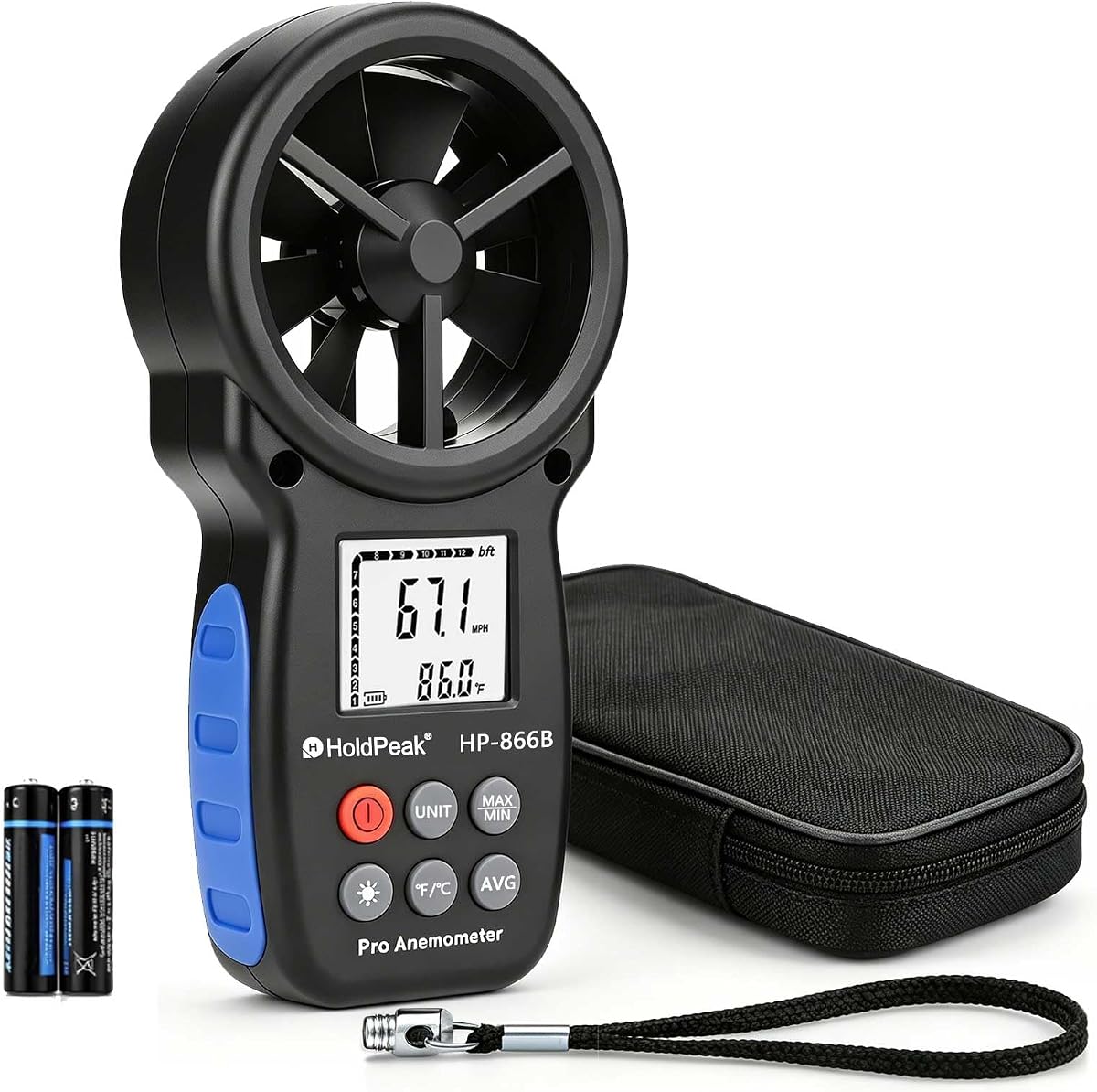
The HoldPeak 866B is engineered with professionals in mind, particularly those working in HVAC and duct ventilation. Its dual temperature sensors and eight fan vanes provide high sensitivity for detecting even very low air flows. This precision is essential for maintaining efficient climate control systems in buildings.
We may earn a commission when you buy through this link, at no additional cost to you.
The included hand strap adds a layer of safety during use ensuring the device does not drop when working at heights or on ladders. The carrying pouch keeps the unit protected during transport to job sites. Users note the reliable performance in real-time monitoring scenarios.
While it does not calculate CFM automatically, the data provided allows for straightforward manual calculation using duct area. This transparency ensures users understand the underlying metrics. The backlight is sufficient for use in dark ducts or basements.
We recommend this model for technicians who need a reliable tool for air quality and flow verification. The durable design and safety features make it a practical addition to any toolkit. It is a solid choice for consistent performance in technical environments.
Eight fan vanes and dual sensors detect low airflows accurately ensuring precise measurements for HVAC and ventilation system inspections.
An included hand strap secures the device to your wrist preventing accidental drops during critical measurements on ladders or high areas.
We may earn a commission when you buy through this link, at no additional cost to you.
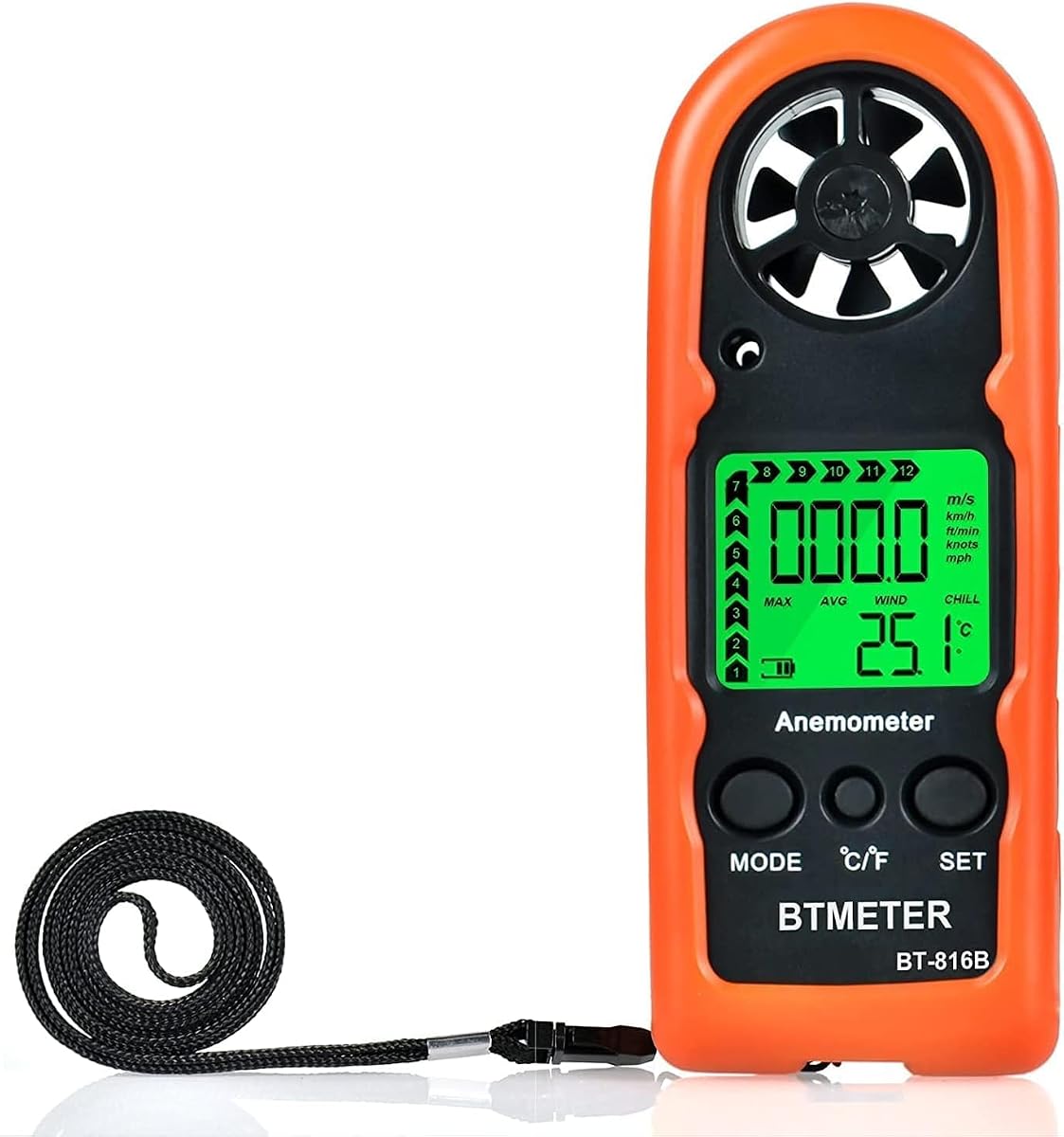
The BTMETER BT-816B is a top choice for those who prioritize portability above all else. Weighing only 53 grams, it slips easily into a pocket or small bag without adding bulk. Despite its size, it delivers accurate readings for wind speed and temperature making it useful for travelers.
We may earn a commission when you buy through this link, at no additional cost to you.
Its wind chill feature is particularly valuable for outdoor safety planning during cold weather activities. The interface is straightforward allowing for quick operation without complex menus. The backlight ensures visibility even in low-light conditions during evening use.
While it lacks humidity sensors, it covers the basics exceptionally well for its size. The auto power-off helps preserve battery life which is crucial for small devices. Customer support is noted as responsive for any technical inquiries.
We suggest this model for hikers or cyclists who need a lightweight wind check tool. Its compact nature makes it easy to carry everywhere you go. If size and simplicity are your main concerns, the BT-816B is an excellent option.
Weighing just 53 grams this anemometer is nearly weightless allowing you to carry it anywhere without burdening your pack or pocket.
Real-time wind chill data helps assess cold risks by combining wind speed and temperature for safer outdoor activity planning.
We may earn a commission when you buy through this link, at no additional cost to you.
The Soonkoda 3 in 1 offers an impressive feature set at a price point that is hard to beat. It measures wind speed, temperature, and level making it a comprehensive tool for general use. Users appreciate the simplicity and ease of operation for quick checks.
We may earn a commission when you buy through this link, at no additional cost to you.
Its wide measurement range covers most common wind conditions encountered outdoors. The Beaufort scale is a helpful addition for assessing wind strength visually. The dual-line display ensures key data remains visible without constant button pressing.
While the build is standard for the price, it functions reliably for casual tasks. The low battery indicator helps prevent unexpected shutdowns during use. It serves well as a backup device or for those on a strict budget.
We recommend this device for occasional users who need basic wind data without advanced features. It is a practical tool for gardening, fishing, or sailing. For its cost, it delivers solid performance and value.
Handle speeds from 0.06 to 30 m/s effectively ensuring versatility for both light breezes and strong gusts in any weather.
Visualize wind force from 1 to 12 to quickly gauge conditions for outdoor activities without complex interpretations.
We may earn a commission when you buy through this link, at no additional cost to you.
The AEM01S POROMETISTO introduces a unique safety feature with its 3-color alarm system. The backlight shifts from green to orange to red based on wind speed levels providing instant visual cues for danger. This makes it exceptionally useful for high-risk environments where quick decisions are necessary.
We may earn a commission when you buy through this link, at no additional cost to you.
Sampling every 0.5 seconds ensures you get real-time data without delay. The ergonomic design makes it comfortable to hold during extended monitoring sessions. The protective housing around the blades helps withstand light impacts during transport.
While the alarm system is automatic it can be intuitive for users needing clear status indicators. The included batteries allow for immediate use upon arrival. The warranty covers quality issues providing additional trust in the product.
We recommend this model for teams or individuals needing safety alerts in industrial or outdoor settings. The visual feedback reduces cognitive load during critical tasks. It is a smart choice for prioritizing user safety in windy conditions.
Backlight changes color to indicate safe, caution, or danger levels providing instant warnings without needing to read precise numbers.
Data updates every 0.5 seconds ensuring you see immediate changes in wind speed for responsive decision making.
We may earn a commission when you buy through this link, at no additional cost to you.
The Proster Digital Anemometer stands out for its ability to calculate volume flow in CFM, CMM, and CMS. This makes it ideal for professionals working on large ventilation systems or air quality testing. The 9V battery supply offers reliable power for longer durations than AAA alternatives.
We may earn a commission when you buy through this link, at no additional cost to you.
The reading hold function allows you to freeze data for recording without holding the device steady continuously. The large LCD backlight ensures visibility in dark ducts or rooms. Users find the interface straightforward for technical tasks.
While the unit is slightly heavier due to the battery compartment it remains manageable. The calculation support reduces manual math work saving time on site. It is a professional tool designed for specific measurement needs.
We suggest this model for engineers or technicians needing direct volume flow data. It streamlines the process of verifying air exchange rates. For those needing calculation features, this device offers clear utility.
Calculate air flow in CFM, CMM, and CMS directly reducing the need for manual equations and speeding up technical inspections.
Freeze the current reading on screen to record data accurately without keeping the device perfectly still during use.
We may earn a commission when you buy through this link, at no additional cost to you.
The VEVOR Split Handheld Anemometer offers unique capabilities with its USB port for PC connection. This allows for data logging and deeper analysis of wind trends over time. The waterproof rating ensures it can withstand rain or splashes during outdoor operations.
We may earn a commission when you buy through this link, at no additional cost to you.
The extendable cord allows you to place the sensor in hard-to-reach spots while reading data on the main unit. This is particularly useful for measuring airflow in high ducts or outside windows. The LED backlight ensures clarity during night-time checks.
While the software setup takes initial time it provides long-term value for detailed reporting. The multi-function design covers temperature and air flow needs effectively. It is a robust solution for industrial or detailed hobbyist applications.
We recommend this model for those needing recorded data for reports or analysis. The connectivity feature sets it apart from standard handhelds. If you need to track changes over days or weeks, this device supports that workflow.
Use the USB port to export data to Windows PCs for detailed analysis reporting trend monitoring over time.
An included 6.6 ft cord lets you position the sensor away from your body for safer measurements in tight spaces.
We may earn a commission when you buy through this link, at no additional cost to you.
Selecting the right anemometer involves considering accuracy, features, and build quality. This section outlines the key factors to ensure you choose a device that meets your specific needs.
Ensure the device covers the speed ranges you expect to encounter. Most handheld models cover 0.67 to 67 mph which suits general applications. Specialized models may offer higher or lower thresholds for industrial needs.
Choose a range that matches your typical operating conditions to avoid inaccurate readings at extreme ends.
Accuracy is critical for professional tasks like HVAC calibration. Look for units with low error margins typically under 5 percent. Higher precision sensors ensure reliable data for decision-making.
Prioritize accuracy for technical work and standard tolerance for casual outdoor hobbies.
A clear LCD with backlight is essential for use in various lighting conditions. Large digits help prevent reading errors. Additional info like temperature and humidity should be visible without constant switching.
Opt for models with clear screens and backlights to ensure ease of use in any environment.
Weight and size impact how easy a device is to carry. Compact models are better for hiking or travel while heavier ones may offer stability. Ergonomic shapes improve grip comfort during long sessions.
Select a design that balances durability with lightweight convenience based on your mobility needs.
Construction materials determine how well the unit withstands drops and weather. Water resistance ratings like IP44 offer protection against rain. Rubber casings prevent slips and absorb shock.
Invest in a rugged build if you plan to use the device in harsh outdoor or industrial environments.
Long battery life reduces interruptions during fieldwork. Auto power-off features help preserve charge. Check if batteries are included or if you need to buy separate power sources.
Choose devices with energy-efficient features to ensure consistent performance without frequent battery changes.
Advanced models offer MAX/MIN/Avg tracking and hold functions. Some support PC connectivity for logging. These features aid in detailed analysis and reporting requirements.
Consider if you need recorded data or just immediate readings to match your documentation needs.
Budget options provide basic functionality while premium models offer extra metrics. Determine which features are essential for your use case. Avoid paying for unnecessary capabilities if basic accuracy suffices.
Balance your budget with required functionality to find the best value for your specific situation.
To start using your anemometer, ensure the batteries are correctly installed and the device is powered on. Allow the sensors to acclimate to the environment for accurate readings. Hold the device steadily in your hand or mount it on a tripod for fixed positions.
When measuring wind, orient the vane perpendicular to the wind direction. If using the wind temperature function, wait a few moments for the sensor to stabilize. Use the hold feature to freeze readings for recording purposes.
Care for your device by cleaning the sensor blades with a soft cloth after use. Store it in the provided pouch to protect it from dust and impacts. Avoid exposing the electronics to excessive moisture beyond its waterproof rating.
An anemometer measures wind speed and air velocity. It is used in HVAC, weather forecasting, sailing, and construction. It helps professionals monitor airflow and safety conditions.
Handheld models typically offer accuracy within 3 to 5 percent. High-end units may provide better precision for professional tasks. Accuracy varies by manufacturer and sensor quality.
Some advanced models include humidity sensors alongside wind speed. Basic units focus on air velocity and temperature. Check the product specs to confirm humidity capability.
Most handheld units are calibrated at the factory. Periodic professional calibration may be needed for strict industry standards. For general use, standard operation is usually sufficient.
Many modern devices have water-resistant ratings like IP44. This protects against light rain but not full submersion. Verify the rating before using in wet conditions.
Yes, many are designed specifically for HVAC duct measurements. They support CFM calculations and airflow testing. Look for models with relevant features for this work.
Most handheld anemometers run on standard batteries like AAA or 9V. Check the power requirements and whether batteries are included with the purchase.
We have reviewed ten top models including the BTMETER BT-100 and Caldwell Wind Wizard II. Each offers distinct strengths for different needs from budget to premium use. Choosing the right device ensures you get reliable data for your projects.
Prioritize accuracy and durability if you use the tool professionally. For casual hobbies, look for ease of use and portability. The right features depend on your specific application requirements.
Always check current pricing and availability as these details change often. We hope this guide helps you find the perfect wind speed meter for your needs. Happy measuring!