
Entina Tina2C 3D Printer for Kids
4.4Editor score
Start in eight minutes
Compact mini footprint
WiFi and offline printing
Discover the top 3D printers for kids in October 2026. We compare safety, ease of use, AI features, and print quality to help you choose the best model for
Finding the right 3D printer for kids involves balancing safety, simplicity, and creative potential. Modern models now include enclosed chambers and AI tools to make design accessible for children without requiring advanced skills. This guide highlights machines that turn imagination into tangible objects safely.
We evaluated each printer based on setup time, software usability, print speed, and safety certifications. Our selection includes fully assembled units with guided apps and cloud libraries to reduce frustration. These criteria ensure that families can start creating quickly without technical hurdles or constant parental intervention.
Each pick below shows specific strengths for different needs like STEM learning or quick toy fabrication. While we highlight key features, prices and availability change frequently. Always check the current listings and support policies before purchasing to ensure the best fit for your household.
4.4Editor score

4.5Editor score

4.4Editor score
This side-by-side comparison highlights key technical specs and unique features across all ten selected printers. Use this table to quickly identify which model offers the best balance of speed safety and creative tools for your child’s age and experience level.


The AOSEED AI 3D Printer for Kids stands out as a top choice for families wanting to blend education with fun. It carries a strong rating and offers a fully enclosed design that keeps hot parts away from curious hands. The AI features allow children to design models using voice or text without needing CAD skills.
We may earn a commission when you buy through this link, at no additional cost to you.
Its standout quality is the vast library of over 8000 human-reviewed models across fun-themed modules. This ensures that kids always find age-appropriate projects like toys or characters. The printer also supports fast speeds and includes eight rolls of PLA so users can start immediately without extra purchases.
While it excels in safety and ease of use, it supports single-color printing only. This means multi-color designs require assembling separate parts which adds a step to the process. However for most young users this limitation is acceptable given the simplified workflow and educational value provided.
This printer is ideal for parents seeking a comprehensive STEM gift that grows with the child. The combination of AI tools safety features and a ready-to-use kit makes it a practical long-term investment. We recommend it for families ready to explore 3D printing together with minimal setup frustration.
Kids can turn doodles or photos into 3D models using built-in AI that simplifies complex design tasks.
The fully enclosed chamber prevents accidental contact with hot nozzles and moving parts during operation.
We may earn a commission when you buy through this link, at no additional cost to you.
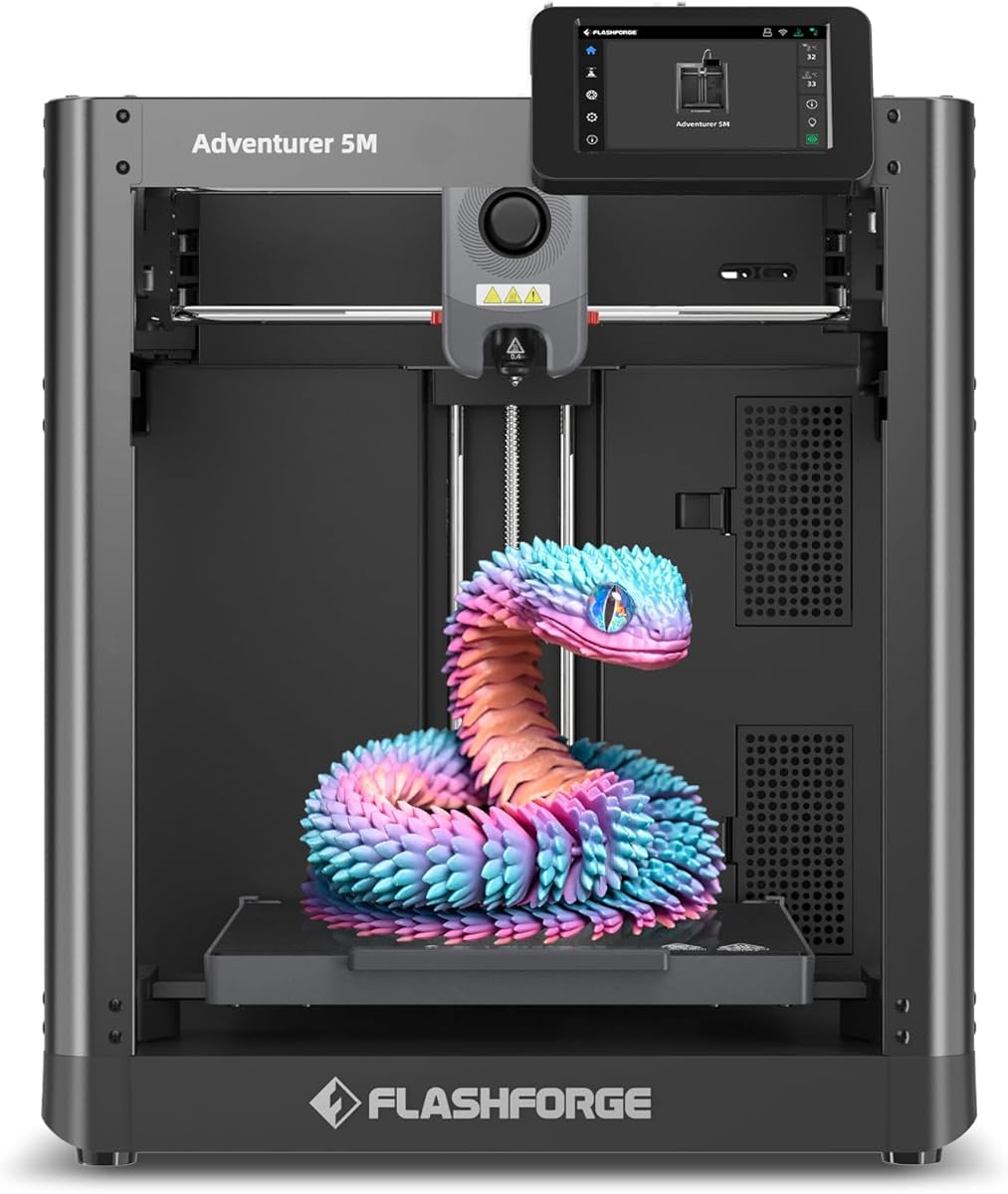
The FLASHFORGE Adventurer 5M brings professional-grade speed to the home environment which can be exciting for older kids interested in rapid creation. It features a CoreXY all metal structure that ensures stability even at high velocities. Automatic bed leveling simplifies setup so users spend more time printing and less calibrating.
We may earn a commission when you buy through this link, at no additional cost to you.
Its key strength lies in the 600mm/s travel speed and quick nozzle changes that keep downtime to a minimum. The direct extruder allows for high flow rates which are useful for larger or more complex builds. This makes it a powerful tool for those ready to move beyond basic starter kits.
However the advanced nature of this machine might be too much for younger children without supervision. The higher speed can also introduce more noise and vibration compared to quieter educational models. Parents should weigh the need for speed against the complexity when choosing for a child.
We suggest this model for teenagers or advanced makers who need efficiency and precision. It is an excellent option for STEM projects requiring quick iterations. If your child is ready for more professional features and can handle the setup nuances this printer delivers impressive results.
High speed and acceleration reduce print times significantly allowing for more iterations in less time.
Remotely monitor print progress and receive alerts via the Flash Studio mobile app for convenience.
We may earn a commission when you buy through this link, at no additional cost to you.
The Entina Tina2C is designed specifically for first-time users and younger children who need a simple start. It is fully assembled and ready to print within eight minutes which reduces the initial barrier to entry. The compact mini footprint makes it easy to place on a desk or shelf without taking up much space.
We may earn a commission when you buy through this link, at no additional cost to you.
Its main strength is the ease of use supported by guided setup through the Poloprint Cloud app. This includes AI-powered search and creative modules that help kids find projects quickly. The auto leveling feature ensures better adhesion so first prints are more likely to succeed.
On the trade-off side the build volume is quite small which limits the size of objects that can be printed. While great for toys and small STEM parts it may not satisfy users wanting larger decorations. This is acceptable for a budget entry point focused on learning basics.
We recommend this printer for families with limited space or those testing interest before investing more. It is an excellent tool for school projects or short creative sessions. The combination of price and usability makes it a strong contender for beginners.
Its tiny footprint fits on small desks making it accessible for kids with limited workspace.
App-based walkthroughs ensure that first-time users can set up and start printing with minimal frustration.
We may earn a commission when you buy through this link, at no additional cost to you.
Magic Jimmy emphasizes AI tools that transform how children approach design by lowering the skill barrier. It includes features like AI MiniMe which turns photos into cartoon figures. The fully enclosed child-safe design ensures that hot components stay out of reach while maintaining a cool-touch exterior for added peace of mind.
We may earn a commission when you buy through this link, at no additional cost to you.
Its key strengths are the integrated camera and magnetic build plate which streamline the workflow. The camera records time-lapses allowing kids to see their creation take shape which keeps them engaged. The magnetic plate makes removing prints effortless reducing frustration at the end of a job.
A trade-off is the heavy reliance on the companion app for accessing the model library and AI features. This means internet connectivity is essential for full functionality which might be a constraint in some environments. Parents should ensure stable Wi-Fi to maximize the printer capabilities.
This model is perfect for tech-savvy families who want to teach digital literacy alongside 3D printing. It turns screen time into creation time effectively. If your child enjoys digital design and wants quick visual feedback this printer offers a compelling experience.
The built-in camera captures time-lapse videos so children can watch their models grow layer by layer.
The magnetic build plate allows for flexible removal of prints without tools or damage.
We may earn a commission when you buy through this link, at no additional cost to you.
The AOSEED X-MAKER AI+ is positioned as a premium educational tool with strong STEM focus. It includes access to creator courses and mini modules that teach design thinking and spatial reasoning. With eight TÜV-tested PLA rolls included it ensures families can start multiple projects right away.
We may earn a commission when you buy through this link, at no additional cost to you.
Its strengths include an ultra-quiet operation that fits well in classrooms or study areas. The 3.5-inch touchscreen simplifies navigation so users can control settings without needing a separate computer. The power-loss recovery feature adds reliability which is helpful for long prints.
The higher price point is a trade-off compared to basic models but it is offset by the included curriculum and materials. This machine is optimized for sustained learning rather than occasional use. Families prioritizing education over cost will find it worth the investment.
We recommend this for households committed to long-term creative learning. It is also a great classroom option where multiple students might use it. The comprehensive kit helps minimize setup friction and keeps learners focused on the creative process.
Integrated mini modules and creator courses provide structured lessons to support educational goals.
The built-in touchscreen allows for direct control without needing external software or computers.
We may earn a commission when you buy through this link, at no additional cost to you.
This Mini 3D Printer Starter Kit offers a complete out-of-box experience for beginners. It arrives fully assembled which reduces the technical barrier significantly. The auto nozzle cleaning feature helps maintain consistent print quality and reduces failed prints caused by clogged nozzles.
We may earn a commission when you buy through this link, at no additional cost to you.
Its key strength is the balance of precision and simplicity. It achieves 0.01mm precision which is impressive for a compact machine meant for kids. The package includes an SD card and test filament so users can print immediately after setup.
One trade-off is that it includes only one roll of filament meaning additional purchases are needed soon. This is manageable for a starter kit but limits the variety of colors initially available. The basic connectivity works well for local SD card printing but lacks smart features.
We recommend this for families wanting a no-fuss introduction to 3D printing. It is reliable and straightforward for school projects. The high precision ensures that finished items look professional which boosts confidence for young creators.
Automatic nozzle cleaning keeps the extruder clear so prints remain smooth and consistent.
Professional grade precision ensures that small details are captured accurately in every print.
We may earn a commission when you buy through this link, at no additional cost to you.
This Magic Jimmy unit focuses on safety and ease of use with a fully enclosed chamber. It allows kids to design and print independently after initial setup thanks to the simplified workflow. The cool-touch exterior ensures that the machine remains safe to touch even after printing.
We may earn a commission when you buy through this link, at no additional cost to you.
Its key strengths include a robust one-tap printing feature that simplifies the process further. Users can browse libraries on iOS Android or Windows making it accessible from various devices. The magnetic build plate remains a consistent benefit for easy removal.
The reliance on cloud connectivity for model browsing means that it may have limitations without internet. This could affect users in areas with unstable connections. However for most homes the cloud integration provides fresh content that keeps projects engaging.
We recommend this for parents prioritizing safety and simplicity above all else. It is a solid choice for independent play. The enclosed design provides confidence for households where safety is the primary concern.
Once set up children can browse and print models with minimal help fostering independence.
The app works on major operating systems so families can use existing devices for design.
We may earn a commission when you buy through this link, at no additional cost to you.
The Entina Tina2C Bundle builds on the basic model by adding four vibrant filament colors. This immediate variety allows kids to try different designs without waiting for more supplies. It keeps the compact footprint of the original while enhancing the creative toolkit with useful maintenance tools.
We may earn a commission when you buy through this link, at no additional cost to you.
Its key strengths are the included LED lighting and power-loss recovery. The lighting ensures clear visibility of print progress which helps kids see details clearly. Power-loss recovery allows prints to resume after interruptions reducing wasted material and frustration.
The smaller build volume remains a trade-off limiting the size of larger projects. This is acceptable for a bundle focused on colorful small toys. The quick-swap nozzle makes maintenance easy and prevents downtime during creative sessions.
We recommend this bundle for kids who enjoy working with different colors right away. It is a thoughtful choice for creative play. The extra filament and maintenance features provide a richer experience than the basic version.
Integrated LED lights provide clear visibility of the build area so users can track progress easily.
Four included colors allow for immediate experimentation with multi-part and colorful designs.
We may earn a commission when you buy through this link, at no additional cost to you.
This unit supports importing STL files from various libraries which adds flexibility beyond its own catalog. It is ideal for users who find specific models online. The integrated AI tools and time-lapse recording keep the workflow engaging for students and hobbyists alike.
We may earn a commission when you buy through this link, at no additional cost to you.
Its key strengths include the ability to browse growing libraries of toys and STEM projects easily. The enclosed safety design ensures that all moving parts are hidden away. The camera feature allows families to capture the creation process effectively.
A trade-off is the need for app setup which may require initial guidance. Offline capabilities are limited so constant internet access is recommended for full usage. This is acceptable for modern homes where connectivity is standard.
We recommend this for families wanting to explore external file sources. It is a powerful tool for advanced learners. The combination of AI and import support makes it versatile for various creative needs.
Users can import STL files from online platforms to expand the range of available models.
Regularly updated models include STEM projects that align with learning goals.
We may earn a commission when you buy through this link, at no additional cost to you.
The Bambu Lab A1 mini stands out as a premium entry point with an LED Lamp Kit included. This unique bundle allows users to print functional light projects right away. It is designed to make 3D printing easy from day one with automatic calibration and a smooth experience.
We may earn a commission when you buy through this link, at no additional cost to you.
Its key strengths are the ecosystem features like MakerWorld which provides a huge library of ready-to-print models. The app integration allows for convenient management and tracking. The printer is fast quiet and reliable fitting naturally into home environments.
The higher entry cost is a trade-off compared to budget options. It also relies on a specific ecosystem which may limit external file management. However for a seamless and enjoyable experience these factors are often acceptable for new users.
We recommend this for families wanting a reliable premium experience. The LED kit adds immediate functional value. If your child is interested in functional decor this printer offers a rewarding and high-quality start.
The included LED kit lets you create working lights which teaches functional design concepts.
Automatic calibration ensures consistent quality without manual tweaking of the bed.
We may earn a commission when you buy through this link, at no additional cost to you.
Selecting the right 3D printer requires balancing features with safety and ease of use. This guide breaks down the most important factors to consider before purchasing.
Safety is the primary concern when choosing a printer for children. Fully enclosed chambers are essential as they keep hot nozzles and moving parts away from curious hands. Look for cool-touch exteriors and pinch-resistant designs. Additionally ensure that the machine supports non-toxic filaments like PLA to avoid exposure to harmful fumes. A safe design gives parents peace of mind while kids focus on creativity.
Always verify that the printer has safety certifications before purchase.
Children and parents alike will benefit from a printer that is fully assembled and ready to use. Models with auto leveling and one-tap printing simplify the workflow significantly. Guided apps or built-in assistants can walk users through the first print. Avoid complex machines that require extensive calibration or technical knowledge as these can lead to frustration.
Choose a model that gets you printing in under ten minutes.
A rich library of pre-made models helps young users find projects quickly. Look for printers with cloud apps that offer themed modules like toys or STEM projects. AI tools that turn drawings or photos into 3D models can lower the barrier to entry. Ensure the software is intuitive and available on your existing devices like tablets or computers.
Check if the library supports regular updates to keep content fresh.
Print speed affects how quickly children see results. Faster machines can complete small toys in minutes keeping enthusiasm high. However speed should not compromise safety or quality. Consider the build volume; mini printers are great for small projects but limit larger creations. Choose a size that fits your workspace and project needs.
Balance speed with build volume for the best results.
Starter kits that include filament and tools offer better value. Extra rolls allow you to try different colors without extra trips to the store. Tools like spare nozzles or magnetic plates simplify maintenance and cleanup. A complete kit helps you start immediately and reduces initial costs.
Look for bundles that include at least one roll of PLA filament.
Quiet operation is vital for home use especially during homework or family time. Machines under 50 dB are ideal as they blend into the background. Compact designs fit easily on desks without cluttering the space. This ensures that the printer remains accessible without dominating the room.
Prioritize low noise for shared living environments.
Modern printers often rely on Wi-Fi for app control and updates. Ensure your home network can support the device. Offline modes like SD card support provide flexibility if connectivity is unstable. Remote monitoring via camera allows you to check progress without interrupting the print.
Verify connectivity requirements match your home setup.
Reliable warranty terms protect your investment. Look for policies that cover repairs for at least a year. Access to responsive technical support is crucial when issues arise. A good warranty indicates manufacturer confidence and reduces long-term costs.
Check the warranty period before making a purchase.
Start by setting up the printer in a well-ventilated area away from direct sunlight. Ensure the bed is clean and level before the first print. Load the provided filament and follow the guided instructions to calibrate. Using the app helps manage files and select models easily.
During operation supervise the first few prints to ensure safety. If the machine is enclosed keep the door closed until finished. Monitor progress via the app or camera to detect any errors early. Always allow prints to cool before removing them to prevent warping.
Regular maintenance keeps the printer running smoothly. Clean the build plate with alcohol to remove residue and replace the nozzle if prints become clogged. Store filament in a dry place to avoid moisture issues. Keeping the unit dust-free extends its lifespan and ensures consistent results.
Yes modern models for kids include enclosed chambers and cool-touch exteriors to prevent burns. Always use PLA filament as it is non-toxic. Supervise young children during setup and printing to ensure they follow safety guidelines.
Most kids printers use PLA filament which is biodegradable and easy to print with. Avoid materials like ABS or PETG unless the machine specifically supports them and has proper ventilation. Always check the manufacturer recommendations before buying new filament.
Small toys typically take 20 to 30 minutes on faster models. Larger items can take several hours. The time depends on the size and complexity of the model and the print speed settings.
Many models allow you to operate via a mobile app using Wi-Fi. Some require a computer for advanced setup. Check the product details to confirm connectivity options before purchasing.
Most modern printers have power-loss recovery that resumes after an interruption. Always check the bed adhesion and temperature settings to prevent failures. Using a reliable model with auto leveling reduces this risk.
Use isopropyl alcohol and a soft cloth to wipe the bed after each print. For stubborn residue use a gentle scrubber. Ensure the bed is dry before the next print to maintain adhesion.
We recommend the AOSEED AI 3D Printer for Kids as the top choice for families wanting a balance of safety and creativity. Its enclosed design and AI tools make it a standout option for young creators.
For budget-conscious buyers the Entina Tina2C offers a reliable entry point with great ease of use. If you seek premium features the Bambu Lab A1 mini provides a seamless experience with unique functional kits.
Prices and availability for these models change frequently so always verify current listings before purchasing. Ensure you choose a printer that matches your child's age and interests to maximize enjoyment.