
RIGOL DHO924S
4.5Editor score
250 MHz bandwidth
Built-in signal generator
Bode plot analysis
50 Mpts memory
Digital oscilloscopes are essential tools for engineers, technicians, and hobbyists who need to visualize and analyze electrical signals. Whether you are debugging a complex embedded system or learning the basics of electronics, a reliable scope provides the clarity and detail required for accurate measurements and effective troubleshooting.
We have carefully evaluated ten leading digital oscilloscope models based on their performance, features, usability, and value. Our comparison focuses on key specifications such as bandwidth, sample rate, memory depth, and connectivity options to ensure you find a device that meets your specific testing needs and budget requirements.
Each selection in this list highlights distinct strengths, from high-resolution displays to advanced protocol decoding capabilities. Please note that product availability and pricing can change frequently, so we recommend verifying current details before making a final purchase decision for your lab or fieldwork setup.
4.5Editor score
4.3Editor score

4.4Editor score
As an Amazon Associate we earn from qualifying purchases.
The following table provides a side-by-side comparison of all ten digital oscilloscope models reviewed in this guide. Use this overview to quickly identify key specifications like bandwidth, channel count, and memory depth to narrow down your choices based on your technical requirements.


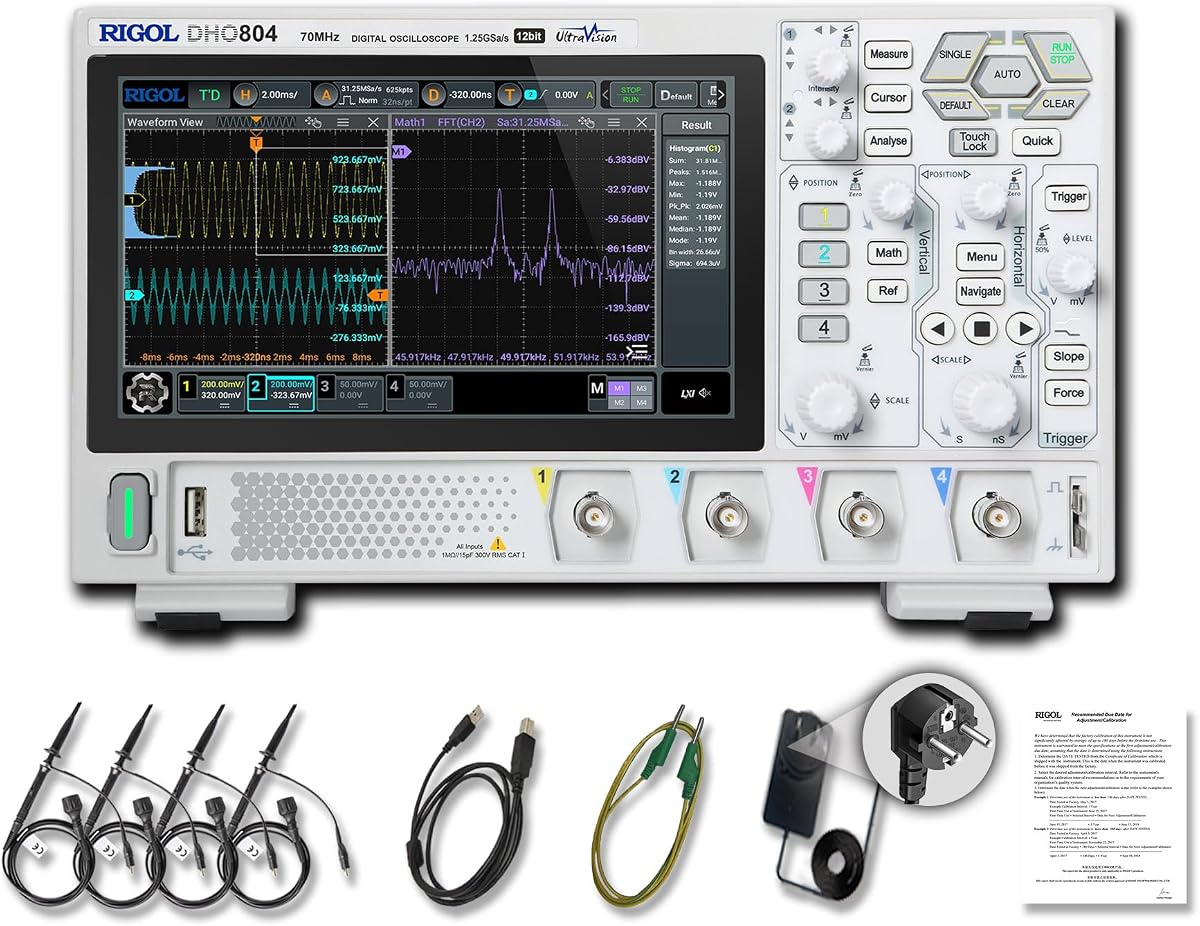
The RIGOL DHO804 stands out as a top contender for engineers needing detailed signal analysis with its 12-bit resolution and 70 MHz bandwidth. It offers four analog channels and robust connectivity options that make it ideal for complex embedded system debugging in lab environments.
We may earn a commission when you buy through this link, at no additional cost to you.
Its UltraAcquire technology captures up to one million waveforms per second, making it exceptionally good at spotting intermittent glitches that other scopes might miss. The device also supports serial decoding for protocols like CAN and SPI, which streamlines troubleshooting for communication buses.
While the 70 MHz bandwidth may not suit high-frequency RF work, the trade-off allows for finer voltage resolution and lower noise floor performance. The 25 Mpts memory depth ensures you can capture long signal sequences without sacrificing sample rate.
This oscilloscope is best suited for professionals who prioritize measurement fidelity and protocol analysis over raw bandwidth. If you need a reliable tool for power supply testing or embedded validation, the DHO804 delivers exceptional value.
The 12-bit vertical resolution provides finer detail in signal amplitude measurements compared to standard 8-bit scopes.
LAN connectivity and web control allow you to operate the scope remotely for automated testing workflows.
We may earn a commission when you buy through this link, at no additional cost to you.
The RIGOL DHO924S is a premium device that combines high bandwidth with advanced analysis tools like Bode plots and a built-in signal generator. It is designed for engineers who need to validate loop stability and frequency response in power systems.
We may earn a commission when you buy through this link, at no additional cost to you.
With 250 MHz bandwidth and 50 Mpts memory, this scope can capture high-speed edges and long records without compromising detail. The inclusion of serial decoding and remote control options ensures it integrates well into modern automation setups.
The Bode plot feature requires an external probe, but it simplifies frequency response testing significantly. The price is higher than entry-level models, but the added functionality justifies the investment for professional applications.
Consider this model if you need both high bandwidth and integrated generator capabilities for comprehensive system validation. It excels in power electronics and high-speed digital design debugging.
The built-in arbitrary function generator allows you to stimulate circuits without needing separate test equipment.
Bode plot analysis helps engineers quickly assess loop gain and phase margin in power supplies.
We may earn a commission when you buy through this link, at no additional cost to you.
The FNIRSI DPOS350P packs impressive bandwidth into a portable handheld unit, making it suitable for field work and on-site troubleshooting. It includes built-in tools like a signal generator and spectrum analyzer that reduce the need for extra equipment.
We may earn a commission when you buy through this link, at no additional cost to you.
With 350 MHz bandwidth and 1 GSa/s sampling, it handles high-frequency signals effectively. The device also offers frequency response analysis, which is rare in handheld units and useful for tuning filters and analog circuits.
Battery life is moderate, but the 8000 mAh cell supports several hours of use. The touchscreen and smart features enhance usability, though the two-channel limit may restrict complex multi-signal analysis.
This is a strong choice for technicians who need high bandwidth and portability. Its multifunctional design makes it a versatile all-in-one tool for various testing scenarios.
The handheld form factor and battery power allow you to take the scope directly to the equipment being tested.
Built-in FFT and frequency response tools simplify signal integrity testing without needing PC software.
We may earn a commission when you buy through this link, at no additional cost to you.
The RIGOL DS1102Z-E is a highly rated model that balances performance and affordability for education and general lab use. Its deep memory and waveform recording capabilities make it easy to capture and review complex events over time.
We may earn a commission when you buy through this link, at no additional cost to you.
With 100 MHz bandwidth and 1 GSa/s sample rate, it handles most standard embedded debugging tasks. The serial decode support for RS232, I2C, and SPI adds value for protocol analysis without extra software.
The interface is straightforward with physical controls, which some users prefer over touch screens for quick adjustments. The LAN and USB connectivity ensure data can be exported efficiently for documentation.
This scope is ideal for students, educators, or professionals needing a dependable workhorse. Its reliability and feature set make it a consistent performer for everyday electronics work.
Deep memory allows you to capture long signal segments while maintaining high resolution for detailed analysis.
Integrated serial decoders simplify the process of analyzing embedded communication bus data streams.
We may earn a commission when you buy through this link, at no additional cost to you.
The FNIRSI 2C53T is a unique hybrid device that combines an oscilloscope, a multimeter, and a signal generator into one compact unit. It is perfect for hobbyists and technicians who need basic testing capabilities without buying separate tools.
We may earn a commission when you buy through this link, at no additional cost to you.
Its 50 MHz bandwidth is sufficient for low-frequency electronics and audio work. The multimeter function supports a wide range of measurements, adding practical utility for daily electrical checks.
While the display is small compared to larger units, the device offers convenient features like waveform saving and reference overlays. The high voltage protection ensures safety during testing.
Choose this model for cost-effective, multifunctional testing. It is an excellent starter tool for learning electronics or handling simple repair tasks.
Having scope multimeter and generator in one unit reduces setup time and equipment clutter on the bench.
The price point makes it accessible for students and beginners entering the field of electronics troubleshooting.
We may earn a commission when you buy through this link, at no additional cost to you.
The FNIRSI DSO152 is the ultimate budget-friendly option for simple signal checks and educational purposes. Its pocket-sized design makes it incredibly convenient to carry around for quick diagnostics on the go.
We may earn a commission when you buy through this link, at no additional cost to you.
With a 200 kHz bandwidth, it is suitable for low-frequency analog signals, Arduino projects, and basic audio work. The auto-set function simplifies operation, making it easy for beginners to get started immediately.
While it lacks high bandwidth and resolution, it is a practical tool for hobbyists who need a second scope or emergency tool. The built-in battery and USB-C charging add to its convenience.
This is the best choice for entry-level users or those needing a compact backup. It offers great value for basic troubleshooting tasks.
Its tiny form factor allows you to carry it in a shirt pocket or toolbox for instant access.
The simple interface and auto functions remove the complexity of advanced settings for new users.
We may earn a commission when you buy through this link, at no additional cost to you.
The Hantek DSO2D15 offers a solid balance of bandwidth and features at a competitive price point. It is well suited for communication, embedded systems, and general lab use where budget is a concern.
We may earn a commission when you buy through this link, at no additional cost to you.
With 150 MHz bandwidth and support for various serial protocols, it covers many common testing requirements. The arbitrary waveform output adds flexibility for generating test signals directly from the scope.
The device is relatively heavy, which may affect portability, but its robust build ensures durability. The multiple trigger modes help isolate specific signal events effectively.
This scope is recommended for cost-conscious professionals needing reliable performance. It delivers essential lab features without breaking the budget.
Built-in decoders for common protocols allow you to visualize bus traffic without needing separate logic analyzers.
Arbitrary waveform output provides a convenient way to test circuit responses to custom signals.
We may earn a commission when you buy through this link, at no additional cost to you.
The FNIRSI 1013D Plus features a large touchscreen interface that simplifies navigation and measurement. It is designed for ease of use, allowing intuitive gesture controls for waveform manipulation.
We may earn a commission when you buy through this link, at no additional cost to you.
With 100 MHz bandwidth and a 7-inch display, it offers a clear view of signals. The waveform image manager supports extensive storage for screenshots and data sets.
Battery life is generous, providing hours of portable use. While the performance is adequate for general tasks, touch responsiveness can vary depending on usage conditions.
Choose this model if you prefer a modern touch interface. It is a practical choice for fieldwork where screen clarity matters.
Capacitive touch and gestures make zooming and scrolling through waveforms much faster than button navigation.
The 7-inch screen provides ample space to view multiple signals and measurement data simultaneously.
We may earn a commission when you buy through this link, at no additional cost to you.
Data for this product is currently unavailable in our system. We recommend checking the listing for the latest details and specifications before making a purchase decision.
We may earn a commission when you buy through this link, at no additional cost to you.
Product information can change over time. Ensure you review the official product page for accurate specs and current availability status.
While we aim to provide comprehensive details, some entries may lack complete data. Always verify with the manufacturer or retailer for the most accurate information.
This placeholder serves as a reminder to double-check product listings for the latest updates. Reliable data is crucial for selecting the right tool.
Always check the official product page for the most accurate and up-to-date specifications.
We may earn a commission when you buy through this link, at no additional cost to you.
Selecting the right digital oscilloscope requires understanding key factors that influence performance and usability. This guide outlines the essential criteria to consider when evaluating different models for your specific needs.
Bandwidth determines the highest frequency signal your scope can measure accurately. Generally, you should choose a bandwidth at least three to five times the fastest signal frequency you expect to measure. Sample rate, measured in samples per second, should be high enough to capture signal details without aliasing. A sample rate at least five times the bandwidth is often recommended for good fidelity.
Memory depth refers to the number of points the scope can store during a single acquisition. A deeper memory allows you to capture longer signal records while maintaining a high sample rate. This is crucial for analyzing complex protocols or long-duration events. Look for models with at least several megapoints if you need detailed time-domain analysis.
Most digital oscilloscopes offer two or four analog channels. Two-channel scopes are sufficient for basic signal comparisons, while four-channel models provide more flexibility for multi-signal analysis. Consider whether you need to measure multiple rails, signals simultaneously for your applications. Additional digital channels can also be useful for logic analysis.
Vertical resolution, typically measured in bits, affects how finely the scope can distinguish voltage levels. Higher resolution means better accuracy in measuring small signal variations. Many modern scopes use 12-bit resolution to provide more detail than the standard 8-bit. Higher resolution is beneficial for power supply ripple analysis or sensitive measurements.
Modern digital oscilloscopes offer various connectivity options such as USB, LAN, and HDMI. These interfaces allow you to export data to a PC, control the scope remotely, or view waveforms on external displays. Look for models that support standard protocols like SCPI for automation. Good software tools enhance documentation and analysis workflows.
Trigger modes help stabilize waveforms for viewing. Advanced scopes offer serial protocol decoding for standards like UART, I2C, and SPI. This feature saves time by visualizing digital bus data directly on the screen. Ensure the scope supports the protocols relevant to your embedded systems work. Reliable triggering is essential for capturing intermittent issues.
If you need to use the oscilloscope in the field, consider models with handheld designs and battery operation. A larger display, such as a 7-inch screen, improves readability in various lighting conditions. Touchscreens can enhance usability but may be less precise than physical knobs. Balance portability with screen quality based on your typical working environment.
Digital oscilloscopes range widely in price depending on performance and features. Determine your specific requirements before purchasing to avoid overpaying for capabilities you do not need. Entry-level models may suffice for hobbyists, while professionals often need higher bandwidth and advanced analysis tools. Investing in a reliable brand ensures better long-term support and accuracy.
Start by connecting the probe securely to the channel input and ensuring the ground lead is attached to the circuit ground. Calibrate the probe by connecting it to the probe compensation terminal on the scope front panel. Adjust the probe trimmer until the square wave appears flat with sharp corners. Proper calibration ensures accurate voltage measurements across all settings.
Set the time base and voltage scale controls to match your signal characteristics. Use the Auto Scale function for a quick initial setup if you are unsure of the signal amplitude. Manually refine the view by zooming in on specific areas of interest for detailed analysis. Use cursor tools to measure time intervals and voltage levels precisely between points on the waveform.
Store captured waveforms and screenshots regularly to a USB drive or computer. Keep the device clean and avoid exposing it to extreme temperatures or moisture to maintain its performance. Turn off the scope properly after use to protect its internal battery if it has one. Regular firmware updates from the manufacturer can provide new features and improve stability.
Analog oscilloscopes display signals directly on a CRT tube, while digital scopes convert signals into digital data for processing and display. Digital models offer advantages like memory storage, waveform analysis, and connectivity options. They are generally more versatile for modern electronics work. Analog scopes may be preferred for real-time waveform visualization in specific educational contexts.
Memory depth determines how long a signal can be captured while maintaining high sample rates. More memory allows you to view both the big picture and fine details in long acquisitions. This is essential for debugging complex communication protocols or intermittent errors. Insufficient memory may force you to sacrifice sample rate for time span.
Select a bandwidth that is at least three to five times the highest frequency component of the signals you intend to measure. For digital signals, consider the fastest edge rate rather than just the clock frequency. Higher bandwidth scopes provide better accuracy for rise and fall times. If you work with RF or high-speed interfaces, prioritize higher bandwidth models.
Serial protocol decoding analyzes digital bus traffic and displays it as readable data like text or packets directly on the screen. Common protocols supported include UART, I2C, SPI, and CAN. This feature significantly speeds up debugging embedded systems by removing the need for manual signal interpretation. It is a key feature for modern embedded engineers.
Yes, digital oscilloscopes are suitable for audio testing to visualize waveforms and measure distortion. Their sample rates are sufficient to capture audio frequencies and harmonic content. Some models even offer FFT analysis to examine frequency spectrum details. They are widely used by audio engineers for signal integrity checks.
A built-in function generator allows you to create test signals like sine, square, or arbitrary waveforms directly on the oscilloscope. This eliminates the need for a separate generator unit, saving bench space and cost. It is useful for injecting signals into a circuit to test its response. Many professional scopes now include this capability.
We reviewed ten digital oscilloscope models offering diverse capabilities from entry-level handheld units to professional lab instruments. The RIGOL DHO804 stands out as a top all-around choice, while the DHO152 offers unmatched value for budget users.
Prioritize bandwidth and memory depth based on your typical signal speeds and duration requirements. For embedded work, ensure the model supports the specific protocols you need to decode for efficient troubleshooting.
Prices and availability can change quickly so check current listings before purchasing. Choosing the right tool will help you achieve precise measurements and streamline your workflow for years to come.